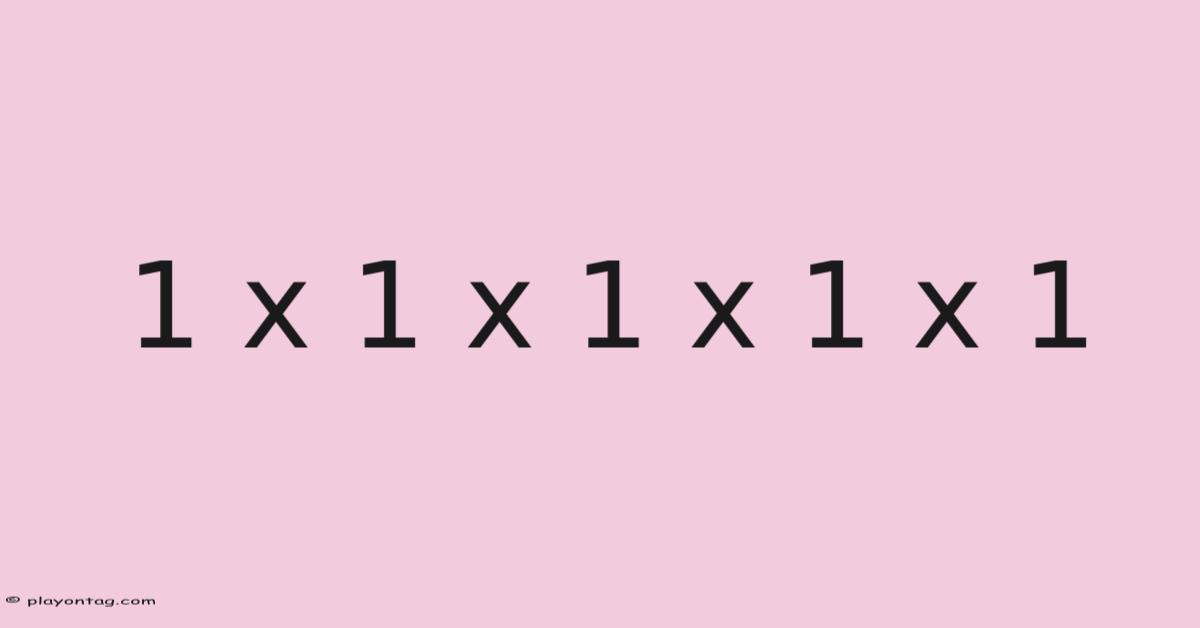
What Is 1 x 1 x 1 x 1 x 1?
Let's just get this out of the way first. In practice, 1 x 1 x 1 x 1 x 1 is five ones multiplied together. It equals 1. Always. No exceptions.
But wait — before you click away thinking "duh," let's dig into why this seemingly obvious fact is actually kind of fascinating.
The Math Behind It
Multiplication is repeated addition. And again. When you multiply 1 by 1, you're asking "what's one group of one?And again. Do it again — 1 x 1 = 1. In real terms, " The answer is still one. And a fifth time.
Each operation preserves the value. One times one gives you one. One times one gives you one. One times one gives you one. One times one gives you one.
The number one is the multiplicative identity. It's the only number that leaves anything unchanged when you multiply by it. That's not just convenient — it's fundamental to how arithmetic works.
Why Not Just Say "1"?
Because the expression 1 x 1 x 1 x 1 x 1 teaches us something about mathematical structure. Also, it shows us how operations compose. It demonstrates the associative property — no matter how you group the multiplication, you get the same result.
(1 x 1) x (1 x 1) x 1 = 1 x 1 x 1 = 1
You could write it as 1⁵, or 1 to the fifth power. But writing out all those multiplication signs makes the process visible. And sometimes seeing the process matters more than the answer.
Why Does This Matter?
Most people would say this is trivial. And sure, it is. But here's what's actually interesting about it.
It's About Identity, Not Complexity
The beauty of 1 x 1 x 1 x 1 x 1 = 1 is that it's an identity operation. Because of that, unlike, say, 2 x 3 x 4 x 5 = 120, which transforms the input dramatically, this expression does nothing. It's a mathematical no-op.
That's actually profound when you think about it. In a world obsessed with change and transformation, the fact that some operations do nothing is worth appreciating. The number one is the gatekeeper of stability in multiplication.
It Builds Intuition About Powers
When students first encounter exponents, they often struggle with what 1⁵ actually means. Writing 1 x 1 x 1 x 1 x 1 makes it concrete. You can count the ones. You can see the pattern.
Try this with other numbers: 2³ = 2 x 2 x 2 = 8. But 1³ = 1 x 1 x 1 = 1. Think about it: the base matters. The exponent matters. Together, they create meaning.
It's a Gateway to Understanding Zero
Here's a thought: 1 x 1 x 1 x 1 x 1 = 1, but what about 0 x 1 x 1 x 1 x 1? That equals zero. One tiny change — replacing a single one with a zero — and the entire result flips.
That's the power of zero in multiplication. It annihilates everything else. One is the identity. Zero is the destroyer. Both are essential to understanding how numbers work.
How Multiplication Actually Works
Let's step back and really look at what's happening when we multiply.
Repeated Addition, Visualized
Think of multiplication as grouping. 3 x 4 means three groups of four objects. Count them up: 4 + 4 + 4 = 12.
Now think of 1 x 1. In practice, that's just... In practice, one group of one object. one object.
Five ones multiplied together? Consider this: you've got one group of one object, which is one object, which is one object, which is one object, which is one object. Still just one object.
The Role of Units
This is where units matter. If you're multiplying 1 meter x 1 meter, you get 1 square meter. The numbers still work the same way, but the units compound.
1 foot x 1 foot = 1 square foot.
1 x 1 x 1 x 1 x 1 with units becomes a conversation about dimensionality. But pure numbers? They're stubbornly, beautifully simple.
Commutativity in Action
You can multiply these ones in any order: 1 x 1 x 1 x 1 x 1 is the same as 1 x 1 x 1 x 1 x 1. The commutative property means order doesn't matter.
Try that with something less polite. 2 x 3 x 4 x 5 x 6 gives you 720. But rearrange it: 6 x 5 x 4 x 3 x 2 still gives you 720. The ones are even more forgiving.
Common Mistakes People Make
Even with something this simple, mistakes happen. Here's what usually trips people up.
Confusing Multiplication with Addition
This is the big one. Some people see 1 x 1 x 1 x 1 x 1 and think: "Well, 1 + 1 + 1 + 1 + 1 = 5, so maybe multiplication works the same way?"
Want to learn more? We recommend american chemical society organic chemistry exam and penicillin was discovered and isolated from a for further reading.
It doesn't. That's the whole point of multiplication being different from addition. Addition combines quantities. Multiplication scales them.
One group of one is one. On top of that, five groups of one added together is five. But that's addition, not multiplication.
Overthinking It
Here's what I've noticed teaching math: sometimes the simplest things make people the most anxiety. They overcomplicate 1 x 1 x 1 x 1 x 1 by looking for hidden tricks.
"There must be a catch," they think. "It can't be this easy."
But sometimes it really is that easy. One times one times one times one times one equals one. Full stop.
Forgetting About Order of Operations
This is more relevant when you add other operations. That said, like 1 + 1 x 1 - 1 ÷ 1. Now you need to remember PEMDAS. But just 1 x 1 x 1 x 1 x 1? No ambiguity there.
Practical Applications
Where does this actually show up in real life?
Scaling Recipes
If a recipe calls for 1 cup of flour, and you want to make 1/5 of it, you multiply by 1/5. But if you're making the full recipe (which is like multiplying by 1), and then you're adjusting portions... well, you get the idea.
Unit Conversions
Converting 1 foot to inches: 1 x 12 = 12 inches. Plus, converting back: 12 inches x (1 foot/12 inches) = 1 foot. All those ones are doing work behind the scenes.
Computer Science Basics
In programming, multiplying by one is a no-op. Compilers actually optimize code by removing "multiply by one" operations because they do nothing.
result = value * 1 * 1 * 1 # The compiler might just make this 'result = value'
Probability and Statistics
In probability, if you have five independent events each with a 100% chance of occurring, the combined probability is 1 x 1 x 1 x 1 x 1 = 1. Still, everything happens. Always.
FAQ
What is 1 x 1 x 1 x 1 x 1 equal to?
It equals 1. Practically speaking, always. No matter how many times you multiply one by one, the result stays one.
Is 1 x 1 x 1 x 1 x 1 the same as 1 to the power of 5?
Yes. Practically speaking, 1⁵ means 1 multiplied by itself 5 times, which is exactly 1 x 1 x 1 x 1 x 1. Both equal 1.
Why does multiplying by one not change the number?
Because one is the multiplicative identity. That's why this is a fundamental property of arithmetic. It's built into the definition of multiplication.
Can you multiply more than five ones?
Absolutely. 1 x 1 x 1 x 1
x 1 x 1 x 1 x 1 x 1 x 1 x 1 x 1 x 1. Now, the answer is still 1. You could multiply one by itself a million times and the result wouldn't budge.
What if one of them is negative?
That changes things. Which means (-1) x 1 x 1 x 1 x 1 = -1. An odd number of negative ones multiplied together yields -1; an even number yields 1. But as long as they are all positive one, the answer remains 1.
Does this apply to matrices or vectors?
Not necessarily. Also, i × I × I = I. In linear algebra, the identity matrix (I) acts like the number 1. But a vector of ones multiplied element-wise is different from matrix multiplication. The scalar rule "1 times 1 is 1" is specific to scalar arithmetic.
Conclusion
We’ve dissected a calculation that fits on a sticky note and found a surprising amount of depth hiding in plain sight.
On the surface, $1 \times 1 \times 1 \times 1 \times 1 = 1$ is trivial. It’s the answer you give when you’re half-asleep. But underneath that simplicity lies the multiplicative identity, the foundation of exponentiation, the logic of empty products, and the reason your compiler deletes lines of code without breaking your program.
It is a reminder that in mathematics, the most unassuming objects often carry the heaviest structural loads. The number one doesn't shout; it just is. It anchors the number line, defines the scale, and ensures that when you multiply something by "nothing" (zero times), you still have a logical place to land.
So the next time you see a string of ones stretching across a page, don't just skip over them. The answer is one. Think about it: it will always be one. Recognize them for what they are: the quiet scaffolding holding the entire operation together. And that consistency is exactly what makes math reliable enough to build bridges, write software, and model the universe.
