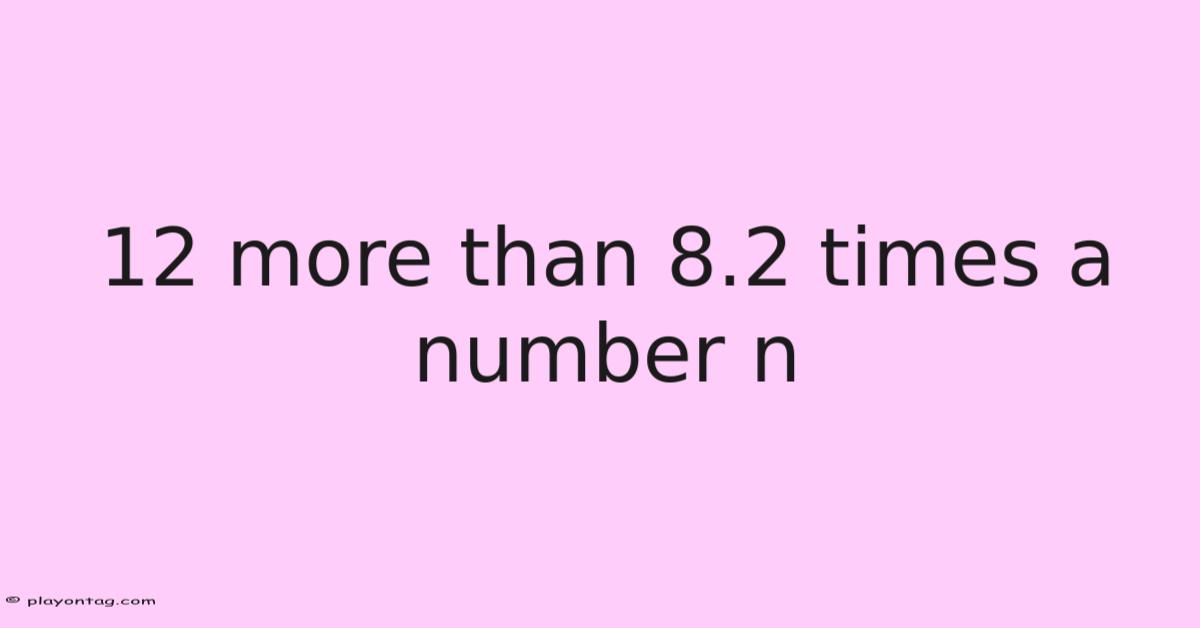
Wait — "12 more than 8.2 times a number n"? That's not a topic, that's a math expression. And honestly, it's a pretty simple one. So why write a whole pillar article about it?
Because here's the thing: most of the confusion around algebra word problems doesn't come from the math itself. Translating English into math is where students get stuck. Plus, it comes from the language. So let's break this one down properly — and while we're at it, you'll learn a trick that works for dozens of similar problems.
What Does "12 More Than 8.2 Times a Number n" Actually Mean?
Let's translate the English into math, piece by piece.
"a number n" — that's just n. A variable standing in for some unknown value.
"8.Plus, 2n, or 8. So that's 8.2 times a number n" — multiplication. 2n.
"12 more than" — this is the part that trips people up. "12 more than" something means you're adding 12 to it*. The "something" comes first, then the 12 gets added on.
So the full expression?
8.2n + 12
That's it. The answer, in algebraic form.
Now, there's a common mistake here. Some people read "12 more than 8.Still, 2 times n" and write it as 12 + 8. 2n, which actually gives you the same thing because addition is commutative. So in this case, the order doesn't change the result. But the meaning* matters when you move to subtraction, division, or more complex phrases. "12 more than n" is n + 12, not 12 + n — well, same answer, different reading. But "12 less than n" is n − 12, not 12 − n. That distinction will bite you later.
The General Pattern
Any time you see "X more than Y," the structure is:
Y + X
"Y" is the base. Also, "X" is what you're adding to it. Always.
So "5 more than a number" → n + 5. "20 more than twice a number" → 2n + 20. Same pattern, every time.
Why This Kind of Problem Matters
Honestly? If you can't translate a phrase like "12 more than 8.This is the foundation for basically everything else in algebra. 2 times a number n" into an expression, you'll struggle with equations, word problems, functions — all of it.
Think about it. Plus, almost every real-world math situation starts with words. Which means a phone plan costs a base fee plus a per-gigabyte charge. In real terms, a car depreciates by a percentage each year. A population grows by a fixed amount annually. Plus, all of these translate into expressions that look exactly like 8. 2n + 12.
So this isn't just textbook busywork. It's the skill underneath the skill.
Where You'll See It
- Word problems in pretty much any algebra course
- Physics formulas — things like "9.8 times the mass plus an initial force"
- Business math — fixed costs plus variable costs
- Every test that has a word problem section
The SAT, the ACT, the GRE, your midterm — they all lean heavily on this. If you can translate "12 more than 8.2 times a number n" in under five seconds, you're already ahead.
How to Translate These Expressions Step by Step
Let's slow down and walk through the actual process. Because knowing the answer is one thing — being able to get the answer on a new problem is what counts.
Step 1: Identify the Variable
What does the problem say is unknown? This leads to " So n is your variable. Here, it's "a number n.Worth adding: write it down. Circle it if that helps.
Step 2: Find the Operation Words
Scan for words that signal math. And "Times" means multiply. Now, "More than" means add. "Less than" means subtract. Consider this: "Divided by" or "split into" means divide. "Of" usually means multiply (as in "half of something").
In our expression, the keywords are:
- "times" → multiplication
- "more than" → addition
Step 3: Put It in Order
Here's where people mess up. The English order isn't always the math order.
"12 more than 8.2 times a number n" — the English reads "12, then 8.2, then n." But the math order?
You take 8.2 times n first (because "8.2 times a number" is a complete unit), then add 12 to that.
8.2n + 12
Step 4: Check by Plugging in a Number
At its core, the step most students skip, and it's the one that saves you from dumb mistakes.
Let's say n = 4. Then 8.On the flip side, 2 times 4 is 32. 8.12 more than 32.8 is 44.8.
Now plug n = 4 into 8.Practically speaking, 2n + 12: 8. 2(4) + 12 = 32.8 + 12 = 44.8.
Match. You're good.
Common Mistakes People Make
I've graded enough of these to know where the errors pile up. Here are the big ones.
Mixing Up the Order
Some folks write 12n + 8.2 instead of 8.But "12 more than 8.2 times n" doesn't say 12 is being multiplied. That's why 2" and just stick the 12 with the n. It's being added*. 2n + 12. Think about it: they see "12" and "8. Keep those separate.
Continue exploring with our guides on acs applied materials interfaces impact factor and what is the temperature of ice water.
Forgetting the Coefficient
A coefficient is just the number in front of a variable. Drop the 8.Also, 2n. Still, 2. "8.2 times n" isn't n — it's 8.2 and your answer is wrong by a factor of 8.Not a small error.
Writing "12 + 8.2n" and Calling It Different
This one's a bit of a trap. Mathematically, 12 + 8.But the standard* way to write "12 more than something" is to put the something first. So if you write it that way on a test, you'll still get the point. 2n and 8.2n + 12 are equal because addition is commutative. Get in the habit now — it'll help when you deal with subtraction, where order does matter.
Confusing "More Than" With "Times More Than"
"12 more than 8." The first is +12. 4n = 106.The second would be 8.In practice, 4n. Worth adding: 2n" is not the same as "12 times more than 8. Totally different beast. Plus, 2n. 2n + 98.2n) = 8.Consider this: 2n + 12(8. Watch for that wording.
Practical Tips That Actually Help
A few things I've seen work — both for students and for anyone brushing up on algebra after years away.
Read the Problem Out Loud
Sounds silly. You catch the "more than" naturally landing after* the 8.When you read "12 more than 8.So 2 times a number n" out loud, your brain hears the structure. Day to day, works surprisingly well. 2n part.
Underline the Key Phrases
Before you write a single symbol, grab a pencil and underline the math words. "Times." "More than.Which means " "Of. So " "Less than. " Each underline becomes a piece of your expression. It's mechanical, but mechanical is good when you're learning.
Always Do the Plug-In Check
Pick a simple number for n. So naturally, if both give the same result, you're golden. In real terms, then run it through your algebraic expression. Run it through the original English phrasing. If not, something's off and you need to find it before submitting.
Practice With Variations
Once you've nailed "12 more than 8.2 times n," try these:
- "7 less than 3 times a number"
- "4 more than half of a number"
- "9.5 times a number, increased by 20"
- "The sum of a number and twice that number"
Each one uses a different combination of operations. The more variations you see, the faster the patterns click.
FAQ
What is the algebraic expression for "12 more than 8.2 times a number n"?
The expression is 8.2n + 12. You multiply n by 8.
How do you translate "more than" into algebra?
"More than" always translates to addition. On the flip side, the phrase that comes before it is the base, and the number after it is what's being added. Here's the thing — in "12 more than 8. 2n," the base is 8.2n, and you're adding 12 to it.
Why isn't 12n + 8.2 correct?
Because 12 isn't being multiplied by n in the original phrase. Still, "12 more than 8. Because of that, 2 times n" means you take 8. 2n as a chunk and add 12 to it — not that 12 gets multiplied by anything.
Does the order of 8.2n and 12 matter?
In pure mathematics, no. 2n. 2n + 12 equals 12 + 8.Addition is commutative, so 8.But writing it in the order the phrase suggests (base first, "more than" amount second) is the standard convention and a good habit.
What if the phrase said "12 times more than 8.2n" instead?
Then you'd add 12 times 8.Even so, 4n. Now, 2n to 8. 2n + 98.That's why 4n = 106. 2n + 12(8.Also, 2n) = 8. Consider this: 2n itself: 8. That's a completely different expression.
A Quick Sanity Check
Let's verify with n = 10:
- Original phrasing: "12 more than 8.2 times 10" = 12 more than 82 = 94
- Algebraic expression: 8.2(10) + 12 = 82 + 12 = 94
They match. The expression is correct.
Now try n = 0:
- Original phrasing: "12 more than 0" = 12
- Expression: 8.2(0) + 12 = 0 + 12 = 12
Still matches. That's the beauty of algebra — it works for every* value of n, not just the ones you test.
Final Thoughts
Translating English into algebra isn't about memorizing a list of rules. It's about recognizing the rhythm of math language. Here's the thing — "More than" is addition. "Times" is multiplication. Because of that, "Less than" is subtraction. "Of" often means multiplication, especially with fractions and percentages.
The expression 8.2n + 12 captures a simple idea: start with 8.Now, 2 times some number, then bump it up by 12. Whether that number represents apples, dollars, or hours, the math stays the same. Once you build that intuition, the rest of algebra — and eventually calculus, statistics, and beyond — becomes a series of the same translation steps, just stacked on top of each other.
So next time you see a phrase like "12 more than 8.Underline the key words, build the expression piece by piece, and check your work. 2 times a number n," don't panic. Plus, you've got the tools. Now use them.
