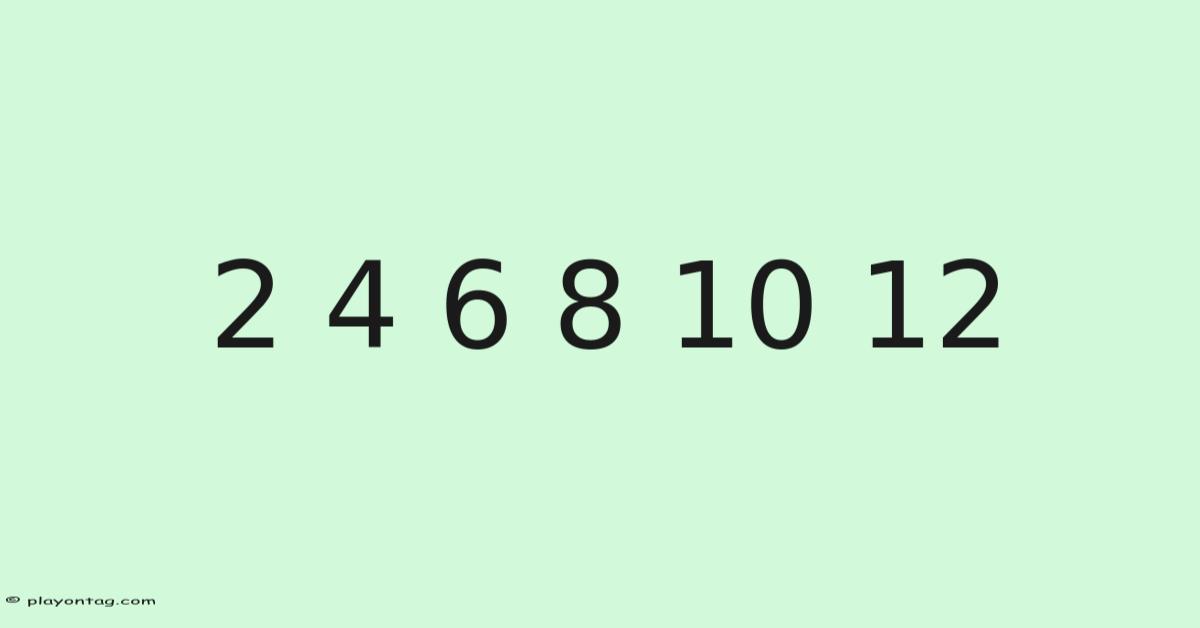
Ever find yourself tapping your foot to a simple rhythm while sorting socks, or humming a quick chant that seems to pop into your head on its own? You’re not alone. And that catchy “2 4 6 8 10 12” pattern is one of those tiny cultural nuggets that slips into conversations, classroom activities, and even office ice‑breakers. It’s the kind of thing that makes people pause, smile, and sometimes wonder—what’s the story behind those numbers? Let’s dive into why this six‑number phrase matters, how it works, and what most people miss when they try to use it.
What Is 2 4 6 8 10 12
At its most basic, “2 4 6 8 10 12” is a short, rhythmic chant that strings together the first six even numbers in ascending order. Kids learn it as a fun way to practice counting by twos, while adults often encounter it as a quick memory‑boost or a playful ice‑breaker. The phrase isn’t just a random sequence; it’s built on a simple mathematical pattern that repeats every two steps, making it easy to remember and extend.
The Origin Story
The exact birth date of the chant isn’t recorded, but it shows up in early 20th‑century children’s folklore and was popularized in the 1970s through a song called “2‑4‑6‑8, Who Do We Appreciate?” The lyrics add a social‑gratitude twist, turning a math exercise into a gentle way to acknowledge someone’s help. Over time, the core numbers became a shorthand for “quick counting” or “simple rhythm” in many cultures.
The Math Behind It
Even numbers are integers divisible by two. This linear progression is the foundation of many counting games and educational tools. Starting at 2, each subsequent number adds two to the previous one: 2, 4, 6, 8, 10, 12, and so on. The chant essentially condenses a basic arithmetic sequence into a memorable, spoken pattern that kids can chant, clap to, or sing along with.
Cultural Impact
You’ll hear variations of this sequence in classrooms, on playground equipment, and even in corporate training videos. That's why it’s used to illustrate concepts like “step patterns,” “rhythmic counting,” and “team coordination. ” The simplicity of the numbers makes them perfect for demonstrating larger ideas—anything from basic addition to the concept of symmetry—without overwhelming the audience.
Why It Matters / Why People Care
Building Early Math Skills
Research shows that rhythmic counting helps young brains lock in number patterns. When a child chants “2 4 6 8 10 12,” they’re not just reciting numbers; they’re internalizing the idea that each step adds the same amount. This lays a groundwork for later concepts like multiplication, skip‑counting, and even algebraic thinking.
Social Glue
The gratitude version of the chant adds a social layer. Here's the thing — in classrooms, teachers use it to praise teamwork; in families, it becomes a light‑hearted way to thank a sibling for sharing toys. Plus, it turns a mechanical recitation into a moment of acknowledgment. The rhythm makes the praise feel rhythmic and memorable, which reinforces positive behavior.
Quick Mental Warm‑up
Even for adults, a quick run‑through of “2 4 6 8 10 12” can serve as a mental warm‑up before a meeting or a workout. Which means the pattern is short enough to fit into a pause, yet long enough to reset focus. It’s a micro‑exercise that signals “let’s get our brains engaged” without requiring any props.
Universal Language
Because the numbers are simple and the rhythm is straightforward, the chant crosses language barriers. A teacher in Tokyo can use the same sequence as a teacher in Toronto, and the message—count, recognize a pattern, feel good about it—remains consistent. That universality is rare for educational tools, which is why the phrase sticks around.
How It Works (or How to Do It)
Step‑by‑Step Counting
- Start at 2 – Place two fingers or a small object to represent the first number.
- Add two each time – Move to 4, then 6, then 8, then 10, then 12.3. Use a beat – Clap, tap, or snap each number to create a rhythmic pulse.
- Extend the pattern – After 12, continue with 14, 16, 18, and so on.
Turning It Into a Song
- Pick a simple melody – Many people use the tune of “Twinkle, Twinkle, Little Star” or a gentle nursery rhyme.
- Add lyrics – The classic “Who do we appreciate?” line works well, but you can also create verses like “2 4 6 8, who’s next in line to be great?”
- Encourage participation – Let kids add hand motions (two fingers for 2, four fingers for 4, etc.) to reinforce the numbers kinesthetically.
Using It in Educational Settings
In the Classroom: Turning Rhythm into Retrieval
When a teacher introduces the chant during a warm‑up, the activity doubles as a low‑stakes assessment. That's why by asking students to raise a hand each time they hear a multiple of two, the educator gauges who is comfortable with skip‑counting and who may need additional reinforcement. The predictable beat also creates a safe space for reluctant learners; the collective rhythm masks individual hesitation, encouraging participation without the pressure of a solo response.
Continue exploring with our guides on how to make zinc copper couple and impact factor of applied materials and interfaces.
Creative Variations to Keep the Moment Fresh
- Reverse Countdown – Starting at 12 and subtracting two each time flips the direction of thinking, reinforcing subtraction as the inverse of addition.
- Cross‑Modal Substitution – Replace the numbers with colors, animal sounds, or emoji icons. To give you an idea, “red, blue, green, orange, purple, teal” spoken in the same cadence helps children map abstract symbols onto concrete patterns.
- Partner Echo – One student initiates the first two beats, and the partner continues the sequence. This peer‑to‑peer interaction builds communication skills while reinforcing the numerical pattern.
Digital Adaptations for Remote or Hybrid Learning
- Slide‑Deck Beats – A PowerPoint or Google Slides presentation can embed a simple metronome sound on each slide transition, cueing the class to vocalize the next number.
- Gamified Apps – Interactive platforms let learners tap a screen in time with a visual cue that lights up at 2‑second intervals, awarding points for correctly identifying the next term.
- Breakout‑Room Challenges – Small groups receive a shared document where they must collaboratively fill in the blanks of a partially completed chant, fostering teamwork even when physically dispersed.
Beyond Numbers: Extending the Concept to Other Domains
The same structural logic can be transplanted into language arts, science, and even social studies. And for instance, a poetry exercise might ask students to recite syllables in a 2‑4‑6‑8 pattern, mirroring the numerical rhythm. In a basic physics demo, the chant can accompany a demonstration of uniform motion, where each spoken number corresponds to a measured distance traveled by a toy car. By anchoring the pattern to diverse content areas, educators create a versatile mnemonic that transcends a single subject.
Practical Tips for Sustaining Engagement
- Vary the tempo – Occasionally speeding up or slowing down the beat keeps the activity from becoming routine.
- Introduce surprise elements – Insert an unexpected word or gesture mid‑sequence to prompt quick thinking and maintain attention.
- Celebrate milestones – When the group reaches a higher multiple, such as 20 or 30, pause to acknowledge the achievement with a cheer or a small reward.
Conclusion
What began as a simple chant of “2 4 6 8 10 12” has evolved into a multifaceted tool that supports early numeracy, social cohesion, and cognitive readiness. By adapting the pattern for classroom instruction, digital platforms, and cross‑subject explorations, educators can harness its flexibility to meet a wide range of learning objectives. Its power lies not in the digits themselves but in the shared rhythm that transforms a rote exercise into an interactive experience. The bottom line: the chant reminds us that even the most elementary sequences can carry profound educational weight when they are woven into the fabric of collective participation.
