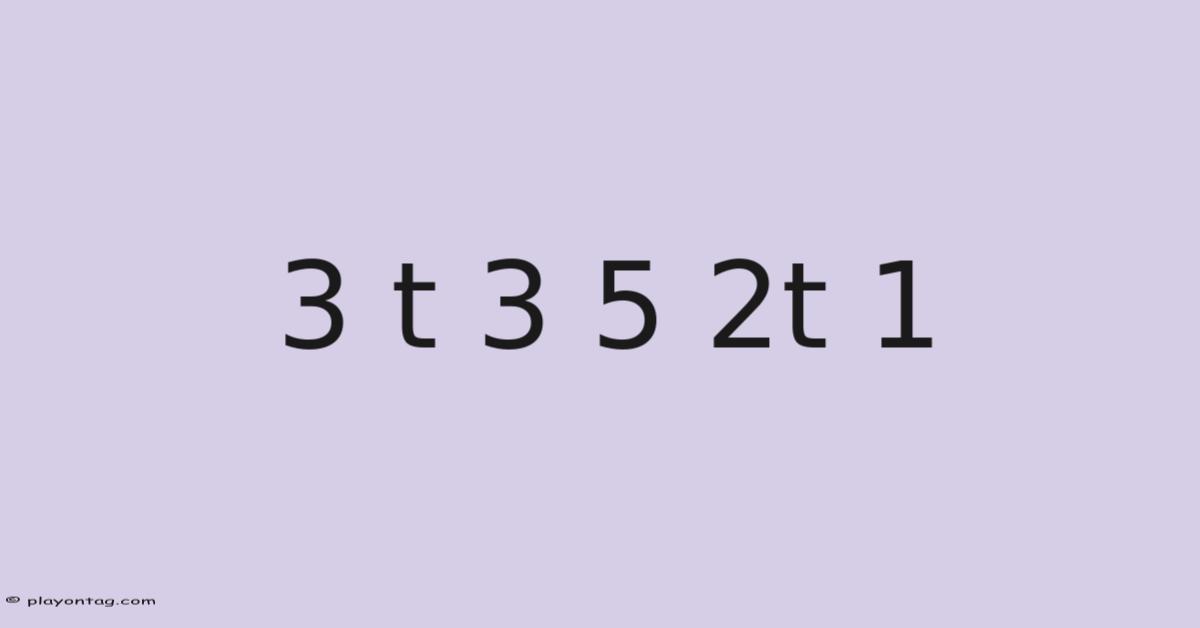
So you've stumbled onto "3t 3 5 2t 1" and you're trying to figure out what on earth that means. Fair question — it looks like a typo, a math problem, or maybe a code for something. Here's the thing: this exact string is the kind of search query that often comes from students hunting for a specific math problem, a particular equation, or a homework answer. Let's break it down, talk about what it most likely is, and actually solve the thing.
What Is "3t 3 5 2t 1"?
The most common version of this problem, the one that shows up in algebra textbooks and homework help sites, looks like this:
3t − 3 = 5(2t − 1)
It's a linear equation with a single variable, t. The spacing in the original query just got mangled — someone typed it fast, lost the equals sign and the parentheses, and the search engine indexed it as a string of characters. If that's the version you're working with, you're in the right place. I'll walk through the whole thing step by step.
But there are a couple of other possibilities worth knowing about, depending on where you saw this string:
- A sequencing puzzle — sometimes these number patterns come from game logic or coding challenges.
- A coefficient list — like the terms 3t, 3, 5, 2t, and 1 appearing in a polynomial.
- A transcription error — the original problem might've been something like "3t + 3 = 5 − 2t + 1" or similar.
The algebra equation is by far the most common. So let's solve it.
Why It Matters (and Why This Trips People Up)
Honestly? So linear equations like this are the gateway drug to all of algebra. So if you can solve 3t − 3 = 5(2t − 1) cleanly, you can handle just about anything that comes next — systems of equations, quadratics, even basic calculus. The real stumbling block with this specific problem isn't the math. It's the parentheses.
Most students get the right idea — distribute, combine like terms, isolate the variable — but they make small sign errors. They forget to flip a sign when moving a term, or they distribute the 5 to only one part of the expression. That's the part worth paying attention to.
How to Solve 3t − 3 = 5(2t − 1)
Let's go slow. No shortcuts.
Step 1: Distribute the 5
The first thing to handle is the parentheses. You've got 5 multiplied by everything inside (2t − 1).
5 × 2t = 10t 5 × −1 = −5
So the right side becomes 10t − 5. Your equation now looks like this:
3t − 3 = 10t − 5
Already cleaner, right?
Step 2: Get all the t terms on one side
You want to gather the variables together. It doesn't matter which side you pick, but I'll move the 3t to the right by subtracting 3t from both sides.
Left side: 3t − 3t = 0 Right side: 10t − 5 − 3t = 7t − 5
So now you have:
−3 = 7t − 5
Step 3: Isolate the t term
Add 5 to both sides to get rid of the constant on the right.
−3 + 5 = 2 7t stays put.
2 = 7t
Step 4: Solve for t
Divide both sides by 7.
t = 2/7
That's the answer. So as a decimal, that's roughly 0. 2857. As a fraction, leave it as 2/7.
Quick sanity check
Plug it back in. Does the left side equal the right side?
Left: 3(2/7) − 3 = 6/7 − 21/7 = −15/7 Right: 5(2(2/7) − 1) = 5(4/7 − 7/7) = 5(−3/7) = −15/7
Same answer. Good — the equation checks out.
Common Mistakes People Make on This Problem
Here's where most of the lost points happen. Watch for these.
Forgetting to distribute the negative
If the original equation had been 3t − 3 = 5(2t + 1), the answer would be wildly different. That said, always write out what each term in the parentheses multiplies to. Don't do it in your head.
Sign errors when moving terms
When you move a term across the equals sign, the sign flips. So a −3 on the left becomes a +3 on the right, and a +5 on the right becomes a −5 on the left. This is where the majority of algebra mistakes come from, period. Not just this problem — all of them.
For more on this topic, read our article on how does temperature affect the rate of a chemical reaction or check out can people be allergic to salt.
Dividing only one term
In step 4, you divide the entire* side by 7, not just the 7t. Once you've simplified the constants down to a single number on one side and a single coefficient times t on the other, the division step is simple. But if you've still got extra constants hanging around, you've missed a step earlier.
Mixing up "combine like terms" with "move across the equals sign"
Combining like terms only works when they're on the same* side of the equation. Because of that, you can't combine 3t and 10t directly until they're on the same side. Tiny distinction, but it's the kind of thing that derails the whole solution if you skip it.
Practical Tips for Solving Linear Equations (That Actually Work)
A few habits that make problems like this almost mechanical:
- Write every step. Yes, all of them. The second you start doing math in your head is the second you start making errors. Especially on homework that gets graded.
- Keep the equals sign aligned. Stack your equation vertically when you can. When everything lines up under the equals sign, it's much easier to see what you actually have.
- Substitute your answer back in. I know it feels like extra work. It takes 30 seconds. And it catches nearly every mistake you'd otherwise turn in.
- Don't rush the distribution step. If there's a coefficient in front of parentheses, that's the first thing you do. Always. Before anything else.
- Keep your work legible. Future you (or your teacher) will thank you. If you can't read what you wrote two minutes ago, you're going to make a sign error.
And one more thing — if the problem doesn't look exactly like the version I solved, double-check the original. A missing negative or a flipped sign in the source problem will give you a completely different answer, and you'll think you got it wrong when really you solved a different equation. Happens more than you'd think.
FAQ
Is 3t − 3 = 5(2t − 1) the only version of this problem?
It's the most common interpretation of the string "3t 3 5 2t 1." But the original could also be something like 3t + 3 = 5 − 2t + 1, which simplifies to 3t + 3 = 6 − 2t and solves to t = 3/5. If your textbook problem has different signs, adjust accordingly.
What if the answer is supposed to be a whole number?
If you're getting a fraction and the answer key says an integer, one of two things happened. Either the equation in the problem is different from the one you're solving, or you made a sign error somewhere along the way. Go back to step 1 and re-distribute.
Can you solve this without distributing first?
Technically, yes — you can divide or rearrange first. But distributing is almost always the cleanest path. If you try to skip it, you'll usually end up with messier fractions and a higher chance of error.
What's the point of solving for t instead of just guessing?
For an equation this small, you could* guess. But guessing doesn't scale. Try t = 1, plug it in, see if it works. Build the habit of solving algebraically now, and you'll thank yourself when the equations get longer and the variables get more numerous.
Wrapping It Up
The answer to *3t − 3 = 5
The answer to 3t − 3 = 5(2t − 1) is t = 2⁄7.
If you substitute it back, both sides give −15⁄7, confirming that the solution is correct. Getting a fraction instead of a whole number isn’t a problem—it just means the original equation was set up that way. When the textbook answer key shows an integer and you’ve landed on a fraction, go back and look for a sign error or a misplaced negative; those are the most common culprits.
Key Takeaways
- Follow the steps you listed: distribute first, keep the equals sign aligned, write out every line, and check your result by substitution.
- Don’t skip the “plug‑it‑back” check. It takes only a few seconds and catches the vast majority of mistakes before you hand the work in.
- Watch the signs carefully. A single misplaced minus sign can flip the answer from 2⁄7 to something completely different.
- Practice the habit, not the shortcut. Guessing works for trivial cases, but algebraic fluency only comes from systematic solving.
Closing Thought
Algebra isn’t about “getting the right number” in a flash—it’s about building a reliable process that works every time, no matter how many variables or terms appear. By writing each step, aligning your work, and double‑checking, you turn a potentially error‑prone task into
a repeatable routine. Master that process now, and the next equation—whether it’s a simple linear one like this or a more complicated system down the road—will feel far less intimidating. So the goal is confidence through consistency, not speed through shortcuts. Keep practicing, stay methodical, and the algebra will take care of itself.
