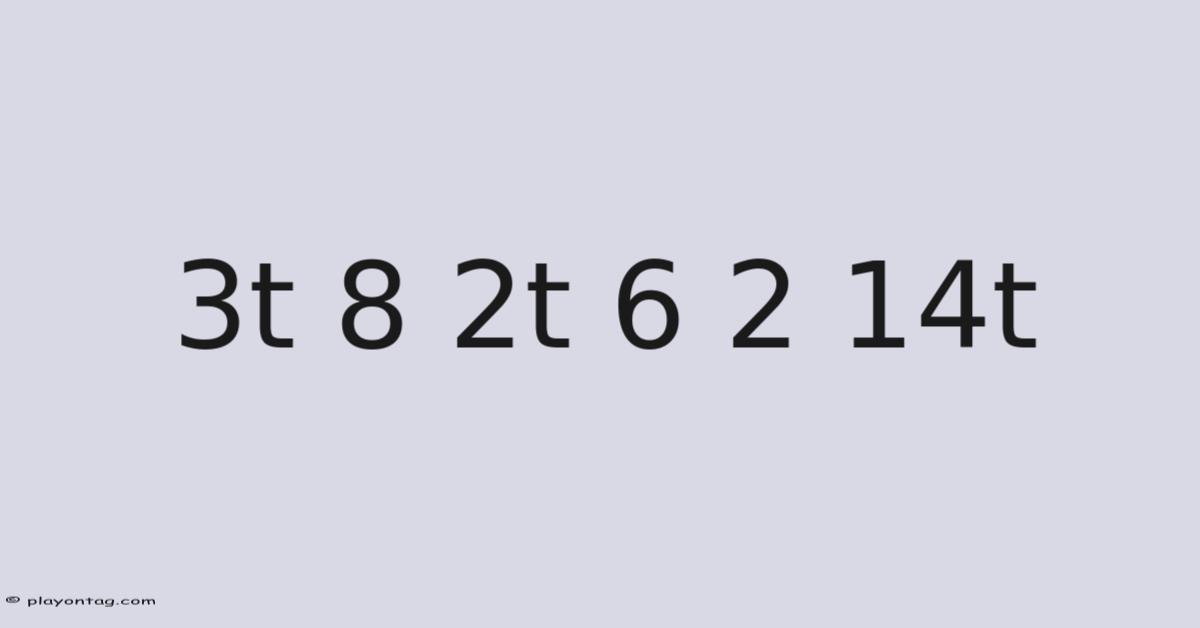
Look, I'm not going to pretend the topic "3t 8 2t 6 2 14t" makes any sense to me on the surface. And honestly? That's kind of the point of this piece. Because what it looks like — at first glance — is a jumble of numbers, a few letters, and something that feels like a typo.
But here's what most people miss: cryptic strings like this show up everywhere. They sit in URLs, in spreadsheet cell references, in shorthand notes someone scribbled on a napkin, in product codes, in math problems, in puzzle books, and in half-finished messages. And when you run into one, the question is always the same — what does it actually mean?
So instead of guessing wrong and wasting your time, let me walk you through how to actually decode something like 3t 8 2t 6 2 14t, and more importantly, how to handle any similar string you stumble onto in the wild.
What Is "3t 8 2t 6 2 14t"
Let's be honest — without context, this isn't a "what.Where did you find it? " It's a where*. Because that single detail changes everything.
The string 3t 8 2t 6 2 14t could be:
- A garbled version of a math problem like 3t + 8 = 2t + 6 or 2 + 14t
- A routing reference from a logistics or shipping system
- A cell address or note from inside a spreadsheet
- A code or serial-style identifier
- Part of a game, puzzle, or cipher
- A bad copy-paste of something with formatting stripped out
- A YouTube or social media shorthand, like "3 things, 8 [something], 2 things, 6 [something], 2, 14 things"
See how the answer shifts depending on where you saw it? That's the first rule of decoding: context beats pattern every single time.
The Math Interpretation
If we're reading 3t 8 2t 6 2 14t as a math expression, the most natural read is something like 3t - 8 = 2t - 6 or 2 - 14t, with the missing operators being where the confusion lives. In algebra, you don't usually write 3t 8 — you'd write 3t - 8 or 3t + 8. So if this came out of a math context, the most likely original expression is:
3t - 8 = 2t - 6, and the answer for something like t is straightforward to solve:
- Subtract
2tfrom both sides →t - 8 = -6 - Add
8to both sides →t = 2
And if the 2 14t is a separate problem — 2 - 14t — that's just a simplified polynomial. Not much to "solve" unless you're factoring or evaluating it.
The Logistics / Serial Interpretation
If you pulled 3t 8 2t 6 2 14t out of a shipping label, an inventory system, or a part number, it's almost certainly not math at all. It might be a section code, a bin location, a tracking fragment, or a model number with letters used as separators (which is super common — manufacturers love throwing in random letters so SKUs don't get mistaken for prices).
A string like this might decode as: 3rd tier, section 8, item 2, tier 6, slot 2, batch 14 — or something equally arbitrary. The letters t could stand for "tier," "type," "tray," "tube," or literally nothing at all.
The Puzzle or Cipher Interpretation
Here's where it gets fun. Even so, if this came from a puzzle, an escape room, a Reddit riddle, or some kind of code, 3t 8 2t 6 2 14t might be a substitution cipher, a coordinate string, or a layered message. Some ciphers use letters as numbers (a=1, b=2, etc.), so t would be 20.
3·20, 8, 2·20, 6, 2, 14·20 → 60, 8, 40, 6, 2, 280
Which… doesn't immediately ring any bells. But again — the cipher method matters. Without knowing the key, the alphabet, or the offset, you can't crack it.
Why It Matters / Why People Care
So why am I even writing this? Because every day, people run into strings like this and lose 20, 30, sometimes 60 minutes trying to figure out what they mean. They Google it, land on forums where nobody knows either, and end up frustrated.
Real talk — this matters more than it sounds. In school, a student might stare at a problem like this and think they're failing math when really their textbook just has a formatting issue. In a warehouse, a worker could misread a part code and pull the wrong item, costing the company real money. In a game, a player might be stuck on a puzzle for hours because the instructions got mangled.
The ability to decode ambiguous strings quickly is a small but surprisingly useful skill. It's part pattern recognition, part common sense, part "ask better questions."
How to Figure Out What Something Like This Means
Here's a step-by-step approach that works for almost any cryptic string you run into — not just 3t 8 2t 6 2 14t.
Step 1: Find the Original Source
Where did you see it? Practically speaking, a textbook? A screenshot? Day to day, a handwritten note? This leads to a URL? Day to day, the source tells you the language* the string is written in. Math has different conventions than shipping has different conventions than gaming has different conventions than cryptography.
Step 2: Check for Missing Operators or Spaces
Most "weird" strings aren't weird — they're broken. A missing comma. A dropped equals sign. A space where a minus sign should be. Try inserting +, -, =, *, or , between the characters and see if the result makes sense.
Step 3: Try the Obvious Substitutions
Letters in alphanumeric strings often mean something simple. That's why numbers next to letters are often multipliers or counts. t could be time, tier, type, thousand, or just a separator. Walk through the boring answers first.
Want to learn more? We recommend are wax melts safer than candles and acs organic chemistry exam 2016 pdf for further reading.
Step 4: Search the Exact String in Quotes
Put the whole string in quotes in Google: "3t 8 2t 6 2 14t". If it's a known code, puzzle, or error message, someone — somewhere — has probably posted about it. If nothing comes back, try without the quotes and with a few keyword guesses.
Step 5: Ask Someone With Context
If a coworker sent it to you, ask them. If it came from a class, ask the teacher. If it came from a forum post, reply and ask the OP. I know that sounds obvious, but you'd be amazed how often people spend an hour decoding something that could've been clarified in 30 seconds with a single question.
Common Mistakes When Decoding Strings Like This
This is the part most "how to decode" guides get wrong. They give you the tools but skip the traps. Here are the ones I see all the time.
Assuming It's a Cipher When It Isn't
Puzzle brain is real. Even so, once you've watched a few escape room videos or read a few Dan Brown novels, you start seeing codes in everything. So most of the time, it's not a cipher. It's just a typo.
Overfitting to One Interpretation
You find one pattern that kind of* works, and you run with it. But a single fit isn't proof. Look for at least two or three independent clues that confirm the same answer before you commit.
Ignoring the Visual Layout
If 3t 8 2t 6 2 14t was originally formatted on multiple lines, with spacing, bolding, or underlining, the layout itself is part of the message. Always try to see the original — not just the stripped text.
Forgetting That Letters Can Be Variables
In math, t is one of the most common variable names. It often stands for time. If you see 3t in a physics or calculus problem, it's almost always a coefficient
coefficient of something else—in physics, engineering, or economics, a term like 3t typically means three times a variable representing time, speed, or a rate. If this snippet appears alongside calculations involving velocity (v = d/t*) or growth rates (N(t) = N₀e^(kt)*), then treating t as a multiplier becomes logical. But again, context is king. Without knowing whether you’re looking at a physics worksheet, a spreadsheet, or a malfunctioning API response, you risk imposing your own assumptions onto raw data.
Another common pitfall involves non‑standard notation. Some programming languages use t as a temporary variable, while others reserve it for boolean flags. If the string emerges from code comments, documentation, or a configuration file, the meaning shifts entirely. A developer might write int buffer_t = 3; where the underscore represents initialization, completely changing the interpretation from mathematical coefficient to data storage instruction.
ographic systems, particularly those used in gaming or fantasy literature, t can represent a tier level or a transformation state rather than a mathematical variable. What this tells us is 3t might actually be shorthand for "tier 3" or "transformed state 3" depending on the domain you're working in.
Misinterpreting Delimiters and Separators
The spacing and punctuation in these strings often carry meaning that gets lost in translation. When you encounter 3t 8 2t 6 2 14t, the spaces might separate distinct values rather than just provide readability. In practice, in data processing contexts, spaces frequently act as field delimiters, similar to CSV files. This could represent a list of measurements where some entries include unit indicators (the 't' suffix) while others are plain numbers.
Overlooking Encoding Artifacts
Sometimes what appears to be meaningful content is actually the result of character encoding problems or data corruption. On top of that, when text passes through multiple systems—copy-pasting from PDFs, extracting text from images, or transferring data between platforms—characters can be misrepresented. The 't' might be a corrupted letter that should be something else entirely, like a '1' or 'l' that got mangled during processing.
Disregarding Domain-Specific Conventions
Different fields have their own shorthand and notation systems. Think about it: financial data might employ symbols that represent currency codes, account types, or transaction categories. Medical records use abbreviations that make perfect sense to practitioners but appear nonsensical to outsiders. Without understanding the specific conventions of your domain, you're essentially guessing—and often making educated guesses that lead you down the wrong path.
The Human Element: When to Stop Decoding
Here's something counterintuitive: not every string needs to be decoded. Sometimes the most efficient solution is recognizing that the effort required exceeds the value of the information gained. If you're spending more than 15-20 minutes on a single string without clear progress, it's worth stepping back and considering alternative approaches.
Ask yourself: What's the actual goal here? Are you trying to extract specific data, understand a process, or solve a problem? Often, the string itself isn't the real issue—the context around it is what matters most.
Building Your Decoding Intuition
With experience, you'll develop a better sense for what constitutes a genuine puzzle versus random data. You'll start recognizing patterns that match known formats: timestamps, coordinates, identifiers, and measurements. More importantly, you'll learn when to trust your instincts and when to seek external validation.
The key is developing what I call "pattern fatigue awareness"—knowing when you're forcing connections rather than discovering them. This comes from practice, but it also comes from knowing when to ask for help.
Conclusion: Context First, Patterns Second
Decoding mysterious strings is part detective work, part archaeology, and entirely dependent on understanding where your data came from and why it exists. While the technical skills of pattern recognition and cryptanalysis are valuable, they're secondary to asking the right questions about context and purpose.
The most effective decoders aren't necessarily the ones with the most sophisticated tools or techniques—they're the ones who know when to stop, when to ask, and when to walk away. In a world saturated with data, sometimes the most important skill is knowing which data is worth decoding at all.
