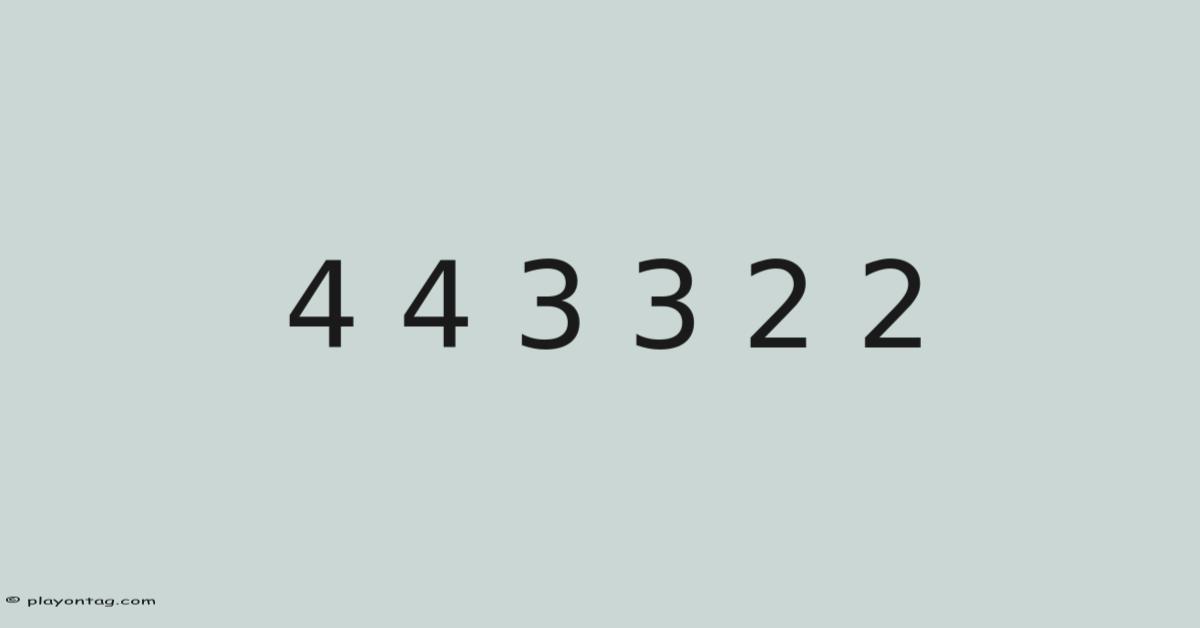
The 4 4 3 3 2 2 Drum Pattern: A Complete Guide
You've heard it a thousand times. That moment in a song when the drums suddenly kick into this driving, relentless pattern — four hits, four hits, three hits, three hits, two hits, two hits — and suddenly the whole track lifts off. It's one of the most satisfying drum fills in popular music, and once you know what it sounds like, you can't unhear it.
That pattern is 4 4 3 3 2 2, and it's one of those drumming concepts that shows up everywhere once you start paying attention.
What Is the 4 4 3 3 2 2 Pattern?
Let me break it down simply: the 4 4 3 3 2 2 is a drum fill built on a descending count. You play four strokes, then four strokes, then three, then three, then two, then two — typically using 16th notes at a steady tempo. The pattern creates a sense of acceleration without actually speeding up, which is kind of its magic.
It lives in that gray area between a simple beat and a full drum solo. This leads to tight enough to groove, loose enough to feel exciting. Consider this: you'll find it in rock, pop, funk, disco, and even some hip-hop production. Drummers use it because it works — it builds tension and releases it in a way that feels natural to almost any genre.
The pattern is usually played across the snare drum and toms, sometimes incorporating the kick drum for extra weight. It can be ghosted lightly or played with full force depending on the musical context. That's part of what makes it so versatile.
Where Did It Come From?
The 4 4 3 3 2 2 pattern doesn't have a single inventor. Plus, they're intuitive. It's more of a natural consequence of how drummers think about fills. Because of that, when you're counting down subdivisions and looking for patterns that feel satisfying, descending sequences just work. You hear the number dropping and your brain expects resolution.
Early rock drummers in the 60s and 70s started using similar ideas. The disco era of the late 70s really embraced it — tracks needed energy, and this pattern delivered exactly that. Here's the thing — by the 80s, it was standard vocabulary in pop drumming. These days, it's everywhere: radio rock, indie, electronic music that samples live drums, you name it.
Why It's Different From Basic Rolls
Here's what separates this pattern from a standard 5-stroke or 7-stroke roll: the changing subdivision count. A 5-stroke roll is the same interval repeated — five hits, evenly spaced. The 4 4 3 3 2 2 shifts the beat groupings, which creates that feeling of acceleration without technical acceleration.
If you play it at the same tempo and dynamic level throughout, it sounds like you're speeding up, even though you're not. That's the psychological trick of it, and that's why producers and listeners respond to it so strongly.
Why It Matters in Drumming
Real talk: if you're learning drums and you only know basic beats, you're missing out on a huge part of what makes drumming exciting. Plus, fills like the 4 4 3 3 2 2 are where drummers express themselves. They're punctuation marks in the music — they tell the listener something's about to happen, or that something just did happen.
Without fills, beats get stale. You can have the tightest pocket in the world, but after a few minutes, people start checking their phones. A well-placed 4 4 3 3 2 2 in a verse-to-chorus transition? That's when heads start bobbing again. That's when the vocalist locks in tighter because they know exactly where the band is headed.
The Psychological Effect
There's actually research on why descending patterns feel satisfying. Our brains love resolution. When you start at four and work down to two, you're creating a narrative arc — tension building, then release. The irregular groupings (four-four-three-three-two-two) keep it from sounding mechanical, but the descent toward the "2" gives it direction.
Play it for someone who's never touched a drum kit, and they'll feel it. Now, they'll want to move. That's why that's not an accident. Drummers have been exploiting this pattern for decades because it reliably creates that response.
How to Play the 4 4 3 3 2 2 Pattern
Alright, let's get into the actual mechanics.
Step 1: Nail the Foundation First
Before you attempt this fill, you need to be comfortable playing steady 16th notes with your hands. That said, make sure each hit is even. So practice a basic single-stroke roll on a practice pad or snare: RLRL RLRL RLRL RLRL (right, left, right, left). If your 16th notes are inconsistent, this pattern will sound messy.
Step 2: Count It Out Loud
Here's how to count the pattern:
4 — 1-e-and-a-2
4 — e-and-a-3-e-and-a
3 — 4-e-and
3 — a-5-e
2 — and-a-6
2 — and-(next measure)
That counts one full bar of 16th notes broken into those six groupings. Now, say it out loud as you tap. Keep a steady tempo. Don't speed up.
If you found this helpful, you might also enjoy what are hand warmers made of or oppolzer radinov total synthesis muscone 1993.
Step 3: Start on the Snare
Begin by playing the entire pattern on your snare drum. In real terms, use alternating right-left-right-left strokes, even if the grouping doesn't divide evenly. This lets you focus on the sticking and timing without worrying about moving around the kit. The alternating sticking keeps it clean.
So it sounds like: R-L-R-L (4) R-L-R-L (4) R-L-R (3) L-R-L (3) R-L (2) R-L (2)
Step 4: Add the Kit Movement
Once you can play it clean on snare, spread it across the kit. A common approach:
- First 4: snare
- Second 4: hi-tom
- First 3: mid-tom
- Second 3: floor tom
- First 2: snare
- Second 2: kick drum (or snare)
This creates a nice sweep across the kit that sounds bigger and more dramatic. You can also stay on the snare and
add ghost notes for texture, or incorporate your hi-hat foot for extra depth. The pattern is flexible — once you understand the grouping, you can orchestrate it however fits the music.
Step 5: Apply It in Context
Playing it in isolation is one thing. On top of that, using it in a song is another. Start by adding it to a simple rock beat: quarter notes on the kick, steady 8ths on the hi-hat, and the 4-4-3-3-2-2 fill at the end of every other bar. Focus on keeping the groove steady while your fill lands precisely on the downbeat of the next measure. The fill should enhance the transition, not disrupt the flow.
Common Mistakes to Avoid
Rushing the small groups. When you hit the "2" at the end, it's tempting to rush those final hits to "catch up." Resist this. The pattern only works if each grouping maintains its duration proportionally. Use a metronome religiously until it's locked in.
Overusing it. This is a powerful tool, but if you deploy it every 8 bars, it loses impact. Save it for moments that need a lift — verse-to-chorus transitions, build-ups before a breakdown, or the final bar before a rest.
Sticking inconsistency. If your RLRL isn't even, the polyrhythmic feel gets buried. Spend extra time on Step 1 before advancing.
Variations Worth Exploring
Once the basic pattern feels natural, try these twists:
- Reverse it: 2-2-3-3-4-4 ascending instead of descending. This creates a sense of building energy rather than resolving tension.
- Start on the "and" of 4: Shifting the downbeat by a 16th note makes the pattern feel less predictable.
- Use doubles: Replace single strokes with diddles on the snare for a heavier accent.
- Incorporate dynamics: Soft hits on the first few groups, then a hard accent on the final "2" for dramatic effect.
When to Use This Pattern
Not every song calls for this fill. It's most effective when:
- The section before needs life injected into it
- You're building toward a climactic moment
- The vocalist or other musicians need a clear signal that a transition is coming
- The tempo is medium (80-120 BPM) — too slow and the pattern feels plodding; too fast and it becomes a blur
In genres like pop, rock, funk, and even metal, this pattern works because it bridges the gap between technical complexity and musical simplicity. Audiences don't need to understand time signatures to feel its pull.
Final Thoughts
The 4-4-3-3-2-2 pattern isn't a magic trick — it's a tool grounded in how humans perceive rhythm and resolution. On top of that, its descending structure mirrors a natural emotional arc: we start uncertain, descend into clarity, and land on certainty. When you play it, you're not just hitting drums; you're guiding listeners through a micro-narrative that ends exactly where they hoped it would.
Master it, use it sparingly, and watch how audiences respond. Sometimes the most powerful things in drumming aren't the flashiest — they're the ones that make people feel something without knowing why.
Now get to your kit and make it happen.
