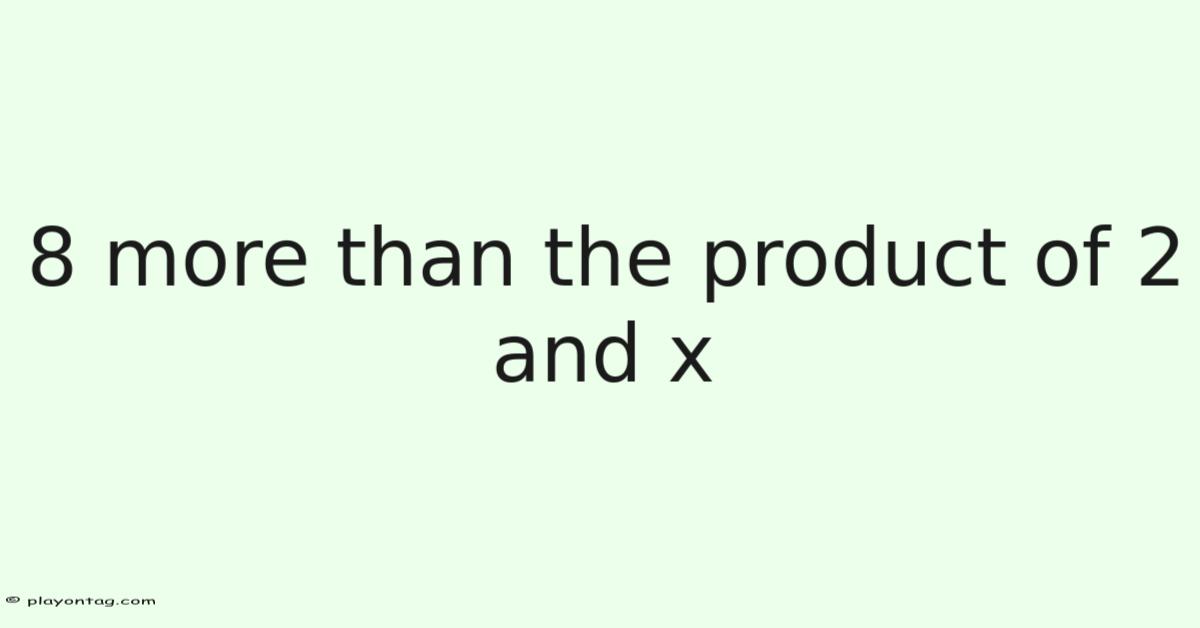
Ever stare at a math problem and feel like it’s a tiny puzzle waiting to be solved? Think about it: you might have seen “8 more than the product of 2 and x” scribbled on a worksheet, a test, or even a coffee‑stained napkin. That phrase sounds like a secret code, but it’s really just a simple algebraic expression that shows up in everything from grocery lists to physics equations. Let’s pull it apart, see why it matters, and figure out how to use it without getting tangled up in unnecessary steps.
What Is 8 more than the product of 2 and x?
The Symbolic Form
When we translate words into symbols, “the product of 2 and x” becomes 2 × x, or simply 2x. Practically speaking, adding “8 more than” means we tack a + 8 onto the front. So the whole thing is 8 + 2x. That’s it — no hidden tricks, just a straightforward combination of multiplication and addition.
Breaking It Down
Think of it this way: first you multiply 2 by whatever x is, then you increase that result by 8. If x equals 3, the product is 6, and 8 more than that is 14. Easy, right? The expression doesn’t care what x is; it just follows the same rule every time.
Why It Matters
Everyday Relevance
You might wonder why anyone would care about a line like 8 + 2x. Say you have a base cost of $8 and each additional item costs $2. In real life, it pops up when you’re budgeting. On the flip side, if x is the number of items, the total cost is 8 + 2x. That’s the same structure as our expression, just with dollars instead of abstract numbers.
The Gap Between Confusion and Clarity
Many students get stuck because they misread the wording. “8 more than” can be easy to flip, ending up with 2x + 8 or even 8 × 2x. Because of that, the key is to keep the order exactly as the sentence tells you: start with the “more than” part, then add the product. Once you see that pattern, the expression stops feeling mysterious and starts feeling like a tool you can wield.
How It Works
Setting Up an Equation
If you need to solve for x, you’ll usually set the expression equal to something else. But for example, “8 more than the product of 2 and x equals 20” translates to 8 + 2x = 20. Now you have a simple linear equation you can tackle with basic algebra.
Solving for x
Subtract 8 from both sides: 2x = 12. That’s the whole process — just two steps. In real terms, the beauty here is that no matter what number x takes, the same steps apply. Then divide by 2: x = 6. It’s a reliable pattern you can count on.
Applying It to Word Problems
Let’s try a word problem: “A gym membership costs a flat fee of $8 plus $2 per class you attend. If you spent $20 total, how many classes did you take?Practically speaking, ” Translate it to 8 + 2x = 20, solve, and you get x = 6 classes. See how the same expression helps you model real situations?
Common Mistakes
Misreading the Order
A classic slip is to write 2x + 8 instead of 8 + 2x. Which means while the two are mathematically identical thanks to the commutative property of addition, the wording “8 more than” tells you to start with the 8. Ignoring that can lead to confusion when you’re translating words into equations.
Forgetting the “more than”
Sometimes people treat “more than” as a multiplier, ending up with 8 × 2x. That changes the meaning entirely. Consider this: remember, “more than” means addition, not multiplication. Keep the plus sign in mind, and you’ll avoid that pitfall.
Overcomplicating the Expression
You might be tempted to expand 8 + 2x into something more complex, like 2(x + 4) or 2x + 8 = (2x + 8). While those are valid transformations, they aren’t necessary for basic understanding. Stick to the simplest form unless the problem specifically asks for a different arrangement.
Practical Tips
Keep It Simple
Every time you see “8 more than the product of 2 and x,” write it exactly as 8 + 2x. Think about it: don’t add extra parentheses or rearrange unless you have a reason. Simplicity keeps you from making algebraic errors.
Use Real Numbers
Plug in easy numbers to test your understanding. Let x = 1, then 8 + 2(1) = 10. Let x = 5, then 8 + 2(5) = 18. Seeing the results helps cement the relationship between the variable and the constant.
Check Your Work
After solving an equation, substitute the value back in. If x = 6 and you think the answer is right, check: 8 + 2(6) = 20. If the left side matches the right side, you’ve got it. This habit catches mistakes before they become habits.
FAQ
What does “product” mean?
The product is the result of multiplying two numbers. In our case, 2 times x gives the product, which we then add 8 to.
Can I use this in a graph?
Absolutely. But if you plot y = 8 + 2x, you’ll get a straight line with a slope of 2 and a y‑intercept of 8. That visual can make the concept click for visual learners.
Is this used in real life?
Yes. Here's the thing — anything that involves a fixed starting amount plus a variable cost — like a base fee plus a per‑unit charge — follows the same pattern. Think of taxi fares, subscription plans, or even certain medical dosage calculations.
How do I teach this to kids?
Use everyday scenarios. To give you an idea, “You have 8 cookies, and each friend brings 2 more cookies. How many cookies do you have if 3 friends come?Here's the thing — ” The answer is 8 + 2 × 3 = 14. Kids grasp the idea when it’s tied to something tangible.
Why is the order of operations important here?
Even though addition and multiplication are both basic operations, the order tells you which part to do first. In “8 more than the product of 2 and x,” you must multiply before you add, because the phrase “product of 2 and x” groups those two numbers together. Getting the order wrong changes the meaning.
Closing
So there you have it — a tidy, approachable look at “8 more than the product of 2 and x.” It’s just a handful of symbols, but those symbols open doors to budgeting, graphing, and solving equations with confidence. Next time you see a problem that mentions “8 more than the product of 2 and x,” you’ll know exactly how to translate it, work with it, and apply it without breaking a sweat. By keeping the wording straight, respecting the order of operations, and testing with real numbers, you can turn a puzzling phrase into a reliable tool. Happy calculating!
Now that you’ve mastered the mechanics, let’s push the idea a little further and see how it slots into larger problems.
Extending the pattern
When you encounter expressions like “ k more than the product of a and x ,” the template stays the same: k + a x. In practice, the only thing that changes is the size of the numbers, but the algebraic structure remains identical. That uniformity is what makes algebra so powerful — once you internalize one instance, you can handle countless variations without relearning the basics.
Example with fractions
Suppose you’re told, “ 3 and a half more than the product of ½ and y .”
- Product of ½ and y = ½ y
- Add 3½ = 7⁄2
So the full expression becomes 7⁄2 + ½ y. Even so, if you need to solve 7⁄2 + ½ y = 9, multiply every term by 2 to clear the denominators: 7 + y = 18, giving y = 11. The same step‑by‑step logic applies; only the arithmetic gets a tiny extra layer.
Continue exploring with our guides on burning of candle is chemical change and can you mix bleach and peroxide.
Real‑world scenario: tiered pricing
Imagine a streaming service that charges a base fee of $8 plus $2 for each additional device you add to your account. Still, if x represents the number of extra devices, the total monthly cost is 8 + 2x. - For 4 extra devices, the bill is 8 + 2 × 4 = $16.
- If you receive a promotional credit of $5 that reduces the base fee, the new cost function becomes 5 + 2x. Plugging in x = 4 yields 5 + 8 = $13.
Seeing the formula in a concrete billing context helps cement why the algebraic form matters beyond the classroom.
Visualizing with tables
| x (extra units) | 8 + 2x (total) |
|---|---|
| 0 | 8 |
| 1 | 10 |
| 2 | 12 |
| 3 | 14 |
| 4 | 16 |
A simple table like this can be a quick sanity check when you’re working on word problems or when you need to explain the relationship to someone who thinks more visually than symbolically.
Common pitfalls to watch out for
- Misreading “more than” as subtraction – The phrase always signals addition, never subtraction.
- Skipping the multiplication step – Remember that “product of a and x” must be computed before you add the constant.
- Over‑complicating with unnecessary parentheses – Keep the expression as k + ax unless a different grouping is explicitly required by the problem.
A quick practice set
- Write the algebraic form for “ 5 more than the product of 3 and z .”
- Solve 5 + 3z = 20 for z.
- If z represents the number of hours you study, and each hour earns you 3 points on a quiz, how many points do you have after 5 hours, given you start with a base of 5 points?
Answers:
1.5 + 3z
2. z = 5
3.5 + 3 × 5 = 20 points.
Final take‑away
The phrase “ 8 more than the product of 2 and x ” may look like a tiny puzzle, but it embodies a universal pattern that appears in budgeting, physics, computer programming, and everyday decision‑making. By translating words into symbols, respecting the order of operations, and testing with real numbers, you turn abstract language into a dependable tool. Keep practicing with varied numbers, contexts, and visual aids, and you’ll find that what once seemed intimidating becomes second nature.
In short: mastering this simple expression equips you with a building block that scales up to far more complex problems. Use it wisely, and let the habit of clean translation guide every algebraic adventure you embark on. Happy calculating!
Beyond the streaming example, the same structure—“base amount plus a per‑unit charge times the number of extra items”—appears everywhere you encounter cost, time, or resource allocation.
From linear to richer models
While the basic form (C = b + kx) describes a straight line, many real‑world situations involve curvature. Suppose a city’s water utility charges a fixed $30 plus $0.15 per kilogram of water used above a baseline of 100 kg. If (y) denotes the total kilograms consumed, the total charge would be expressed as
[ \text{Cost}(y)=30+0.15,(y-100). ]
Here the coefficient (0.In real terms, 15) plays the role of the “per‑device” rate, while the shift ((y-100)) removes the baseline from which the variable part starts. Recognising whether a problem calls for a pure linear term or one that adjusts for an offset is the first step toward setting up the correct equation.
Translating language into algebra
The key skill is converting everyday phrasing into the symbolic pattern “constant + (product of a constant and a variable).” To give you an idea, “three times the square root of (t) added to twelve” becomes (12+3\sqrt{t}). When you see such constructions, pause and ask yourself three questions:
- What is the fixed component?
- Which quantity varies?
- How does that varying quantity contribute to the total?
Answering those prompts usually yields the appropriate literal form without needing to memorize a list of formulas.
Reinforcing the habit through practice
To make the connection stick, interleave short drills with longer, contextual problems. A useful routine might include:
- Mini‑challenge: “If a gym membership costs $25 per month and each additional class adds $7, write the total cost as a function of the number of classes taken.” → Answer: (C(x)=25+7x).
- Multi‑step scenario: “A delivery service charges $12 for the first package and $4 for each subsequent package. Three packages are ordered. What is the total charge?” → Break it down: base (12), then (2) extra packages at (4) each gives (12+2·4=20).
- Real‑world twist: “A concert ticket costs $60 plus $5 for every group of five people that buys together. If a school group of 27 students purchases tickets together, compute the total price.” → Here the per‑group factor changes (here (x) counts groups, so (x=\lfloor27/5\rfloor=5) full groups, leaving 2 singles). The calculation would be (60+5·5=85).
Working these exercises regularly trains your brain to spot the underlying linear template automatically, even when the narrative grows more elaborate.
Connecting algebra to other disciplines
Once the linear model feels natural, you can map it onto geometry, finance, or biology. In physics, the distance traveled under uniform acceleration is (d = v_0 t + \tfrac12 a t^2); the term (\tfrac12 a t^2) mirrors the “(k x)” part of our cost formula. In chemistry, the ideal‑gas law can be rearranged to solve for pressure given volume and temperature, again expressing a constant plus a product of variables. Seeing algebra in these domains reinforces its versatility and shows that the skill is a gateway rather than an isolated trick.
A final reminder of good habits
- Write the expression before simplifying. Even if you later combine terms, having the original form keeps the reasoning transparent.
- Check units early. In the streaming example, the unit of (x) is “extra devices,” while the monetary unit is dollars. Mis‑matching them leads to nonsensical answers.
- Read the question twice. The first reading often captures the core operation; the second ensures you haven’t missed a hidden condition (e.g., a discount applied only after a certain threshold).
By cultivating these practices, you transform a simple cost‑function into a flexible mental tool that can be adapted to anything from budgeting a household to analyzing data trends in research projects.
Conclusion
The transformation of words into the compact algebraic structure “constant + (k·variable)” is more than a classroom exercise; it is a foundational bridge between language and quantitative thinking. When you recognize the pattern
the fixed baseline, the per‑unit rate, and the quantity that scales, you gain a reusable lens for dissecting problems across disciplines. Worth adding: whether you are projecting next quarter’s expenses, estimating the materials needed for a construction job, or modeling population growth in a biology lab, the same structural insight applies. Mastering this translation turns ambiguous narratives into precise, manipulable equations, empowering you to ask “what‑if” questions, optimize outcomes, and communicate quantitative reasoning with clarity. In short, the ability to build and interpret linear cost functions is not merely an algebraic skill—it is a fundamental component of analytical literacy that will serve you long after the final exam.
