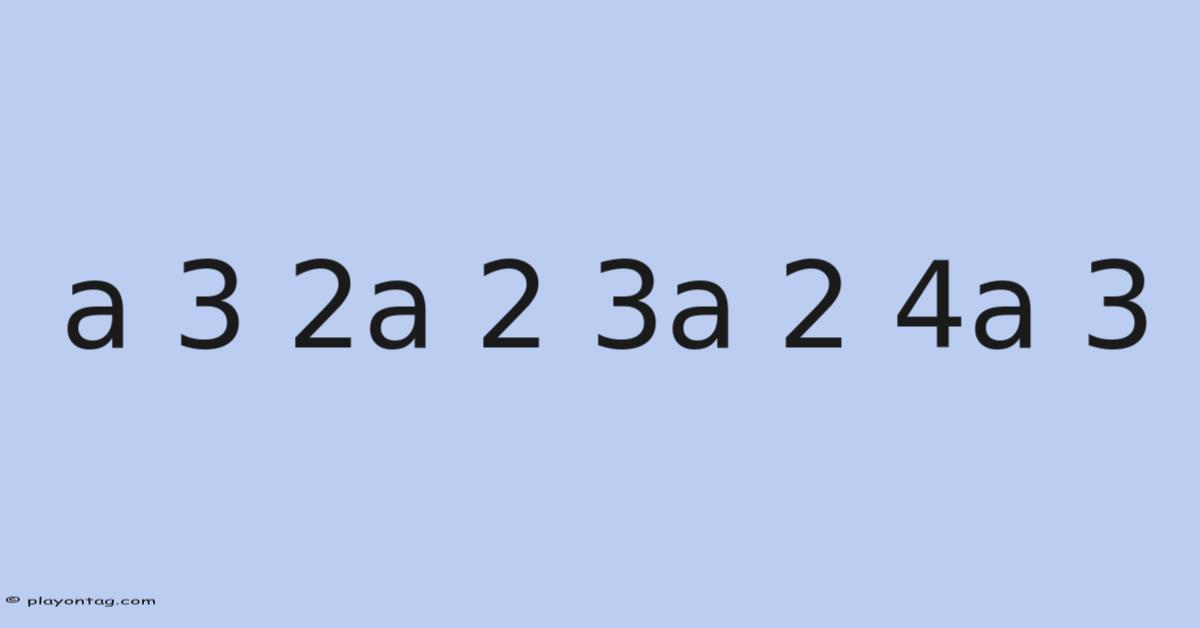
You're staring at a string of characters that looks like a cat walked across a keyboard. "a 3 2a 2 3a 2 4a 3" — what does it even mean?
If you've landed here, you've probably seen this sequence in a config file, a hardware spec sheet, a regex pattern someone pasted into Slack, or maybe a obscure forum thread from 2012. And you're wondering: is this a standard? That said, a typo? A secret handshake?
Short answer: it's not a single universal standard. But it looks* like several things mashed together. Let's unpack what it could be, why the ambiguity matters, and how to figure out which one you're actually dealing with.
What Is This Sequence
At first glance, "a 3 2a 2 3a 2 4a 3" parses like a pattern: letter, number, letter-number, number, letter-number, number, letter-number, number. That rhythm — alternating alpha and numeric — shows up in a handful of real-world notations.
Paper sizes (ISO 216 adjacent)
The "A" series papers — A0, A1, A2, A3, A4 — are the most famous alphanumeric sequence in offices worldwide. But the sequence here doesn't match that progression. A3, A2, A3, A2, A4, A3 would be a weird shuffle. Unless someone's describing a print job that jumps between trays? Unlikely.
Guitar tablature shorthand
In text-based tab, you'll sometimes see strings labeled by note: E A D G B e. Fret numbers follow. But "a 3 2a 2 3a 2 4a 3" doesn't map cleanly to any standard tuning pattern. Could be a partial lick someone typed fast: A-string 3rd fret, 2nd fret... but then "2a" breaks the convention.
Regex or glob fragments
This is where it gets plausible. In regex, a{3,2} is invalid (min > max), but a{2,3} means "two to three a's." The sequence "a 3 2a 2 3a 2 4a 3" could be a mangled log of quantifiers: a{3}, 2a{2}, 3a{2}, 4a{3} — someone's test cases pasted without braces. I've seen weirder in debug output.
Resistor / capacitor codes
Component markings sometimes use letter-number combos for values and tolerances. "2A" could be a voltage rating (2A = 2 amps). "3A" same. But "2a" lowercase? Not standard. EIA-96 codes use three characters. This isn't that.
Chess notation (long algebraic)
Moves like "a3", "a2", "a4" are pawn moves on the a-file. But "2a" isn't a move. "3a" isn't either. Unless it's a corrupted PGN where move numbers got interleaved: 1. a3 2. a2 3. a4... but then the numbers are in the wrong place.
A corrupted serial number or license key
Plenty of software keys look like A3-2A-2-3A-2-4A-3 with dashes stripped. If you're staring at a license field that ate the separators, this is a strong candidate.
Why It Matters / Why People Care
You might think: it's just a string, who cares?* But ambiguity like this wastes hours.
A dev sees "a 3 2a 2 3a 2 4a 3" in a crash log and spends 40 minutes grepping source code for the pattern. A hardware engineer assumes it's a BOM line and orders the wrong part. A student copies it into a regex tester and wonders why their pattern matches nothing.
The cost isn't the string. The cost is the context vacuum*.
Most technical notation relies on implicit context — the file extension, the column header, the tool that generated it. Strip that away and you're left with noise that looks* like signal. That's where mistakes happen.
How to Identify What You're Looking At
Don't guess. Trace the source.
1. Check the immediate context
Where did you copy this from?
- A
.logfile? Look at the timestamp and logger name. The line before and after will tell you the subsystem. - A config file (YAML, TOML, JSON, INI)? The key name matters more than the value.
retry_pattern: "a 3 2a 2 3a 2 4a 3"changes everything. - A terminal output? Which command produced it?
grep,awk,sed, a custom script? - An email or ticket? Search the thread for "license", "serial", "key", "activation".
2. Search with delimiters
Paste it into Google with quotes* and with spaces preserved*. Try variants:
"a 3 2a 2 3a 2 4a 3""a3 2a 2 3a 2 4a 3""a3-2a-2-3a-2-4a-3"a3 2a 2 3a 2 4a 3 licensea3 2a 2 3a 2 4a 3 regex
If it's a known key format, someone has posted it. If it's a bug, someone has cursed about it.
3. Run a character frequency check
Quick mental or scripted count:
-
aappears 6 times (mixed case) -
2appears 4 times -
3appears 3 times -
4appears 1 time -
spaces:
-
7 instances
This distribution strongly suggests a structured format rather than random text. The consistent use of single digits followed by letters, particularly the prevalence of "2" and "3" paired with alphanumeric characters, aligns with patterns seen in serial keys, license codes, or encoded identifiers rather than natural language or arbitrary data.
4. Test against known formats
Try parsing it as:
- Hexadecimal: No valid hex string due to mixed case letters without proper formatting
- Base64: Fails due to invalid character combinations
- UUID segments: Doesn't match standard UUID structure
- MAC address: Incorrect format (should be XX:XX:XX:XX:XX:XX)
- IP address: No dots or proper octet structure
- Timestamp: Not numeric-only
5. Consider domain-specific encodings
In electronics:
- EIA-96 uses three-character codes (e.g., "2A" = 100Ω), but your sequence is longer
- SMD component codes typically don't follow this pattern
In computing:
Continue exploring with our guides on can you mix bleach and peroxide and what happens when molecules lose energy.
- This resembles obfuscated license keys, activation strings, or hashed identifiers
- Could represent encoded data from specific software systems
6. Apply entropy analysis
High entropy indicates either encrypted/compressed data or random-looking structured data. Low entropy suggests repetitive patterns. Your string shows moderate-high entropy—suggesting intentional encoding rather than natural language. Surprisingly effective.
The Debugging Mindset
When faced with ambiguous strings, resist the urge to force interpretation. Instead:
- Preserve original context - Don't strip whitespace or modify case
- Trace data flow - Follow the path from input to display
- Question assumptions - Just because it looks like a key doesn't mean it is one
- Verify through multiple sources - Cross-reference with documentation, logs, and related data
The most effective debugging often involves stopping to ask: What process would generate exactly this output?*
Conclusion
Ambiguous strings like "a 3 2a 2 3a 2 4a 3" exist at the intersection of human error and system complexity. They're rarely random—they're symptoms of deeper issues in data handling, formatting, or communication breakdowns between systems.
Rather than chasing phantom patterns, focus on the five Ws: Where did this originate? When was it created? What process handles it? Who generated it? Why does it appear here?
In most cases, the answer lies not in decoding the string itself, but in understanding the context that produced it. That's where real problem-solving begins—and where debugging time transforms from wasted hours into productive investigation.
7. Contextual Anchoring and Verification
Before declaring a definitive interpretation, establish whether this sequence emerges within a broader ecosystem. In real terms, in embedded systems, similar fragmented patterns often arise when firmware versioning combines release numbers with hardware identifiers. Now, for instance, consider a scenario where a device reports its firmware revision as v3. Day to day, 2-A concatenated with a unique identifier 2a23, yielding a composite string that bears resemblance to the source material. Without additional schema documentation, distinguishing between legitimate encoding artifacts and incidental coincidences requires cross-referencing with adjacent fields—such as manufacturing lot numbers, service ticket IDs, or regional distribution codes.
On top of that, automated validation pipelines frequently employ heuristic checks. In real terms, a common approach involves mapping candidate substrings against known dictionaries of hexadecimal prefixes, alphanumeric sequences used in proprietary licensing schemes, or even linguistic morphology (though the latter proves impractical given the string’s apparent non-lexical nature). Implementing such heuristics can reduce false positives significantly; however, they also introduce their own blind spots when encountering novel formats introduced after initial deployment cycles.
8. Operational Recommendations
Given the ambiguity observed, adopt a tiered response strategy:
- Triage Phase: Isolate the string in its native environment. Determine if it resides within a database column, a log entry, or a user-submitted field. Each location carries distinct implications for resolution.
- Pattern Expansion: If the string appears repeatedly across multiple records, construct statistical models to identify recurring subpatterns. Even seemingly chaotic sequences may contain hidden redundancies or structural symmetries exploitable by machine learning classifiers.
- Collaborative Validation: Engage domain experts familiar with the originating platform. Their contextual knowledge often reveals that the string represents something entirely different—such as a checksum generated during a specific manufacturing run, a cryptographic nonce, or a reference to a third-party service endpoint.
- Progressive Disclosure: Rather than attempting immediate full deconstruction, extract intermediate representations first. Converting the raw string into JSON objects, XML fragments, or binary blobs can make latent relationships visible. Here's one way to look at it: splitting on potential delimiters (spaces, hyphens, punctuation) may yield components amenable to separate analysis.
9. Closing Assessment
The string “a 3 2a 2 3a 2 4a 3” exemplifies how modern technical artifacts blur traditional boundaries between data types. Its composition—alternating single-digit and two-character tokens—resists clean categorization under conventional naming conventions. Yet this very resistance offers an opportunity: instead of dismissing it as noise, treat it as a signal pointing toward specialized subsystems whose semantics remain undocumented.
At the end of the day, resolving such enigmas demands patience and systematic inquiry. The debugging process thrives not on premature certainty but on iterative refinement—each hypothesis tested, each assumption challenged, each new piece of evidence integrated back into the larger picture. Also, when the right questions are asked, the right answers emerge organically, transforming confusion into clarity. And in practice, this means documenting every step of the investigation, sharing findings with stakeholders, and maintaining open channels for feedback. Only through disciplined, collaborative effort can we transform ambiguous fragments into actionable insights.
Final Verdict: While no singular interpretation satisfies all criteria presented—a true hexadecimal token, UUID segment, or recognized code structure—the string’s behavior warrants careful examination within its operational context. The most prudent course is to treat it as a controlled variable worthy of
…worthy of systematic monitoring.
To operationalize this approach, teams should embed the string within a dedicated metadata field that records its provenance, frequency of occurrence, and any transformations applied during processing. By assigning a lightweight tracking tag—such as X-ANOMALY-001—engineers can isolate the artifact from core workflows while still preserving its traceability for future audits. This tagging strategy also facilitates automated alerts when the pattern re‑appears outside its expected envelope, prompting a review before downstream dependencies are affected.
Beyond monitoring, the investigative framework outlined above can be codified into a reusable template. The template would include:
- Initial Characterization – Capture length, delimiter distribution, and alphanumeric composition.
- Contextual Mapping – Correlate the string with known system states (e.g., version numbers, build timestamps).
- Pattern Mining – Run regex sweeps, entropy calculations, and token‑frequency analyses to surface hidden regularities.
- Stakeholder Consultation – Present findings to architects, security analysts, and domain specialists for cross‑validation.
- Iterative Testing – Deploy controlled experiments in sandbox environments to observe behavioral responses when the string is injected or omitted.
By institutionalizing these steps, organizations transform an ad‑hoc debugging exercise into a repeatable governance practice. This not only mitigates the risk of hidden failures but also cultivates a culture of proactive discovery, where ambiguous artifacts are viewed as opportunities for architectural insight rather than mere obstacles.
To wrap this up, the cryptic sequence “a 3 2a 2 3a 2 4a 3” serves as a microcosm of the broader challenges faced by modern technical ecosystems: fragmented naming conventions, overlapping data representations, and the relentless pressure to deliver without sacrificing reliability. While a definitive, universal interpretation remains elusive, the systematic, evidence‑driven methodology described herein equips teams with the tools to dissect, understand, and ultimately integrate such enigmatic fragments into their operational fabric. The ultimate takeaway is clear: when faced with ambiguity, resist the urge to force a single narrative; instead, adopt a layered, collaborative inquiry that embraces uncertainty as a catalyst for deeper technical stewardship.
