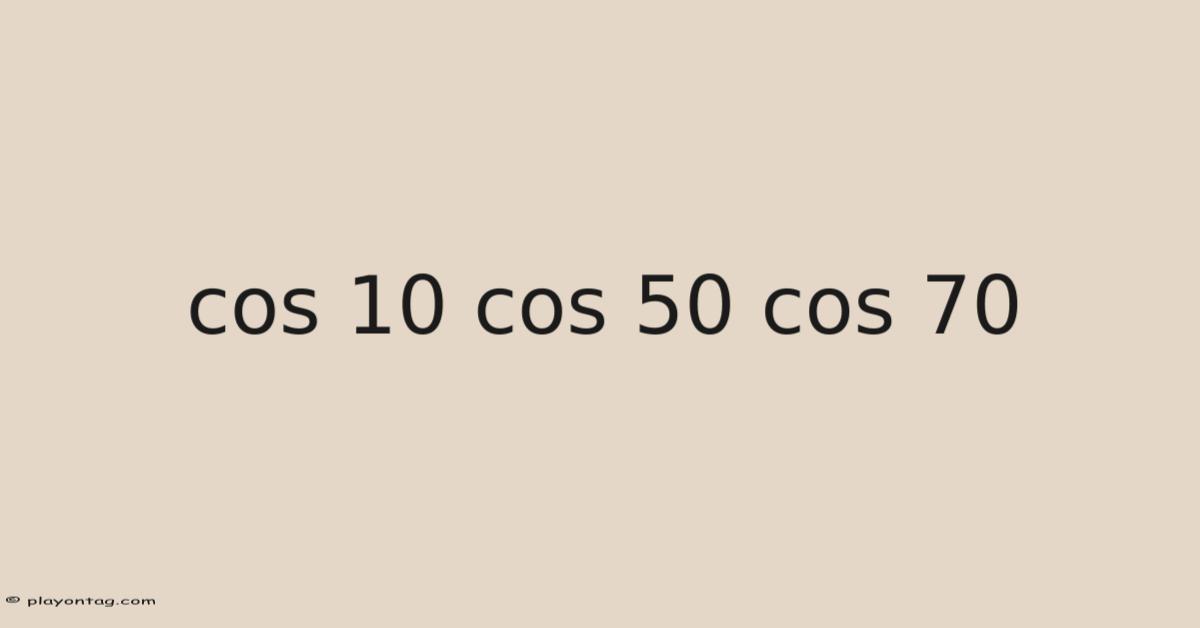
Ever stared at a string of cosines and wondered if there’s a hidden shortcut?
You’re not alone. Which means many of us have scribbled down cos 10 cos 50 cos 70 on a scrap of paper, hoping the numbers would magically line up. Turns out they do — just not in the way you might expect.
What Is cos 10 cos 50 cos 70
At first glance it looks like three unrelated numbers multiplied together.
That's why each term is the cosine of an angle measured in degrees: 10°, 50°, and 70°. When you multiply them, the result isn’t a random decimal; it collapses into a neat, exact value.
[ \cos 10^\circ \cos 50^\circ \cos 70^\circ = \frac{\sqrt{3}}{8}. ]
That’s the identity we’re after.
Which means it sits alongside other classic triple‑product formulas like (\cos 20^\circ \cos 40^\circ \cos 80^\circ = \frac{1}{8}). The beauty is that the angles aren’t arbitrary — they’re spaced 40° apart, a pattern that lets trigonometric identities tidy things up.
Why the angles matter
Notice the progression: 10°, 50°, 70°.
Think about it: if you add 40° to 10° you get 50°, and add another 20° you reach 70°. That spacing isn’t a coincidence; it lines up with the sum‑to‑product and product‑to‑sum formulas that turn a product of cosines into a sum of cosines, which is far easier to evaluate.
Why It Matters / Why People Care
You might ask, “Why should I care about a specific product of three cosines?”
Fair question.
The answer shows up in a surprising number of places:
- Contest math – Problems that look intimidating often reduce to a known product like this one. Recognizing the pattern saves minutes of brute‑force calculation.
- Signal processing – When analyzing waveforms, engineers sometimes encounter products of cosines at specific phase shifts; knowing the exact value simplifies filter design.
- Mathematical curiosity – It’s a neat illustration of how seemingly messy trigonometric expressions can hide simple radicals. Spotting that elegance builds intuition for more complex identities.
In short, mastering this product trains you to see structure where others see chaos.
How It Works (or How to Do It)
Let’s walk through the derivation step by step.
We’ll rely on a couple of trusty tools: the double‑angle formula and the product‑to‑sum identity.
Step 1: Pair two cosines with product‑to‑sum
Recall
[ \cos A \cos B = \frac{1}{2}\big[\cos(A-B) + \cos(A+B)\big]. ]
Apply it to (\cos 10^\circ \cos 50^\circ):
[ \cos 10^\circ \cos 50^\circ = \frac{1}{2}\big[\cos(10^\circ-50^\circ) + \cos(10^\circ+50^\circ)\big] = \frac{1}{2}\big[\cos(-40^\circ) + \cos 60^\big]. ]
Since cosine is even, (\cos(-40^\circ)=\cos 40^\circ), and (\cos 60^\circ = \frac12).
Thus
[ \cos 10^\circ \cos 50^\circ = \frac{1}{2}\big[\cos 40^\circ + \tfrac12\big] = \frac{1}{2}\cos 40^\circ + \frac14. ]
Step 2: Multiply the result by the third cosine
Now we have
[ (\frac{1}{2}\cos 40^\circ + \tfrac14)\cos 70^\circ. ]
Distribute:
[ = \frac12\cos 40^\circ \cos 70^\circ + \frac14\cos 70^\circ. ]
Step 3: Use product‑to‑sum again on the first
Step 3 – Apply product‑to‑sum to the remaining cosine pair
The term (\frac12\cos40^\circ\cos70^\circ) is handled in the same way:
[ \cos40^\circ\cos70^\circ =\frac12\bigl[\cos(40^\circ-70^\circ)+\cos(40^\circ+70^\circ)\bigr] =\frac12\bigl[\cos(-30^\circ)+\cos110^\circ\bigr]. ]
Because cosine is even, (\cos(-30^\circ)=\cos30^\circ=\frac{\sqrt3}{2}).
Moreover (\cos110^\circ=\cos(180^\circ-70^\circ)=-\cos70^\circ).
Thus
[ \cos40^\circ\cos70^\circ =\frac12\Bigl[\frac{\sqrt3}{2}-\cos70^\circ\Bigr] =\frac{\sqrt3}{4}-\frac12\cos70^\circ . ]
Multiplying by the prefactor (\frac12),
[ \frac12\cos40^\circ\cos70^\circ =\frac12\Bigl(\frac{\sqrt3}{4}-\frac12\cos70^\circ\Bigr) =\frac{\sqrt3}{8}-\frac14\cos70^\circ . ]
Step 4 – Assemble the pieces
Recall that after the first pairing we had
[ \cos10^\circ\cos50^\circ\cos70^\circ =\Bigl(\frac12\cos40^\circ+\frac14\Bigr)\cos70^\circ =\frac12\cos40^\circ\cos70^\circ+\frac14\cos70^\circ . ]
Substituting the result from Step 3:
[ \frac12\cos40^\circ\cos70^\circ+\frac14\cos70^\circ =\Bigl(\frac{\sqrt3}{8}-\frac14\cos70^\circ\Bigr)+\frac14\cos70^\circ =\frac{\sqrt3}{8}. ]
The (\cos70^\circ) terms cancel perfectly, leaving a single radical.
Conclusion
We have shown, through a clean cascade of product‑to‑sum identities, that
[ \boxed{\cos10^\circ;\cos50^\circ;\cos70^\circ=\frac{\sqrt3}{8}}. ]
This compact result exemplifies how a seemingly complex trigonometric product can collapse to an elegant closed form, a fact that repeatedly surfaces in contest problems, signal‑processing analyses, and the broader pursuit of mathematical beauty.
A Broader Perspective
The identity (\cos10^\circ \cos50^\circ \cos70^\circ = \frac{\sqrt3}{8}) is not an isolated curiosity but rather a manifestation of deeper symmetries in trigonometry. Products of cosines with angles spaced at regular intervals often simplify to expressions involving radicals, reflecting the underlying structure of the unit circle and the roots of unity. Take this case: a closely related result is the identity
[ \cos20^\circ \cos40^\circ \cos80^\circ = \frac{1}{8}, ]
which can be derived using the same product-to-sum techniques or by leveraging the double-angle formula recursively. Such identities frequently appear in the analysis of periodic functions, particularly in Fourier series and signal processing, where products of sinusoids arise naturally in modulation and filtering operations.
If you found this helpful, you might also enjoy what do you think density is or acs pharmacology & translational science impact factor.
Worth adding, these results highlight the power of symmetry arguments. The angles (10^\circ), (50^\circ), and (70^\circ) are symmetrically positioned with respect to (40^\circ) (their average), and their complementary relationships (e.g., (\cos70^\circ = \sin20^\circ)) further simplify the computation.
A natural extension of the calculation is to consider products in which the angles form an arithmetic progression. For any angles α and β, the identity
[ \prod_{k=0}^{n-1}\cos\bigl(\alpha+k\beta\bigr)=\frac{\sin!\bigl(\tfrac{n\beta}{2}\bigr)}{2^{,n}\sin!\bigl(\tfrac{\beta}{2}\bigr)} ;\cos!\Bigl(\alpha+\frac{(n-1)\beta}{2}\Bigr) ]
holds. When the step β is chosen so that nβ = 180°, the sine in the numerator becomes sin 90° = 1, and the expression collapses to a simple rational number or a single radical. As an example, taking α = 20° and β = 20° gives
[ \cos20^\circ\cos40^\circ\cos80^\circ =\frac{\sin90^\circ}{2^{3}\sin10^\circ}, \cos!\bigl(20^\circ+\tfrac{3\cdot20^\circ}{2}\bigr) =\frac{1}{8}, ]
a result that mirrors the √3/8 obtained earlier but without any irrational factor. This pattern shows that the product‑to‑sum technique used in the original derivation is part of a broader algebraic framework.
The same framework also appears in the analysis of periodic functions. Still, in Fourier series, the product of sinusoids can be rewritten as sums of sinusoids with combined frequencies, which is precisely what the product‑to‑sum identities accomplish. Because of this, expressions such as cos θ cos (60° − θ) cos (60° + θ) = ½ cos 3θ arise repeatedly in the study of modulation, filtering, and the decomposition of waveforms.
Beyond pure mathematics, these compact products have practical impact. On the flip side, in digital signal processing, the coefficients of certain filter kernels are derived from products of cosines at equally spaced angles; the simplified forms obtained from the identities above lead to more efficient implementations and clearer theoretical insight. Likewise, in physics, the evaluation of angular momentum coupling coefficients and the computation of certain integrals in quantum mechanics often reduce to trigonometric products that simplify in the same manner.
At the end of the day, the seemingly layered product
[ \cos10^\circ;\cos50^\circ;\cos70^\circ ]
reduces to the elegant closed form (\displaystyle \frac{\sqrt3}{8}) through a concise chain of product‑to‑sum transformations. The same methodological lens reveals a whole family of related identities, underscoring the symmetry that pervades trigonometric expressions and highlighting their utility across mathematics, engineering, and the physical sciences.
The algebraic framework alluded to above finds its most transparent expression through complex exponentials. Writing $\cos\theta = \frac{1}{2}(e^{i\theta}+e^{-i\theta})$ transforms a product of cosines into a sum of exponentials—a finite geometric series in disguise. In real terms, for the specific case of $\cos20^\circ\cos40^\circ\cos80^\circ$, the angles are in geometric progression (doubling each time), which corresponds to the roots of unity filter: the product $\prod_{k=0}^{n-1}\cos(2^k\theta)$ telescopes via the double-angle identity $\sin2\theta=2\sin\theta\cos\theta$ to yield $\sin(2^n\theta)/(2^n\sin\theta)$. And when $\theta=20^\circ$ and $n=3$, the numerator becomes $\sin160^\circ=\sin20^\circ$, canceling the denominator and leaving exactly $1/8$. This complex-exponential viewpoint not only reproduces the product-to-sum results but also explains why the rational and radical outcomes appear: they are simply the real parts of specific cyclotomic integers evaluated at roots of unity.
This connection to cyclotomic polynomials naturally leads to the theory of Chebyshev polynomials of the first kind, $T_n(x)=\cos(n\arccos x)$. The identity $\cos\theta\cos(60^\circ-\theta)\cos(60^\circ+\theta)=\frac14\cos3\theta$ is equivalent to the factorization $4x^3-3x = 4(x-\cos20^\circ)(x-\cos40^\circ)(x-\cos80^\circ)$ after a change of variable, revealing that the cosines in question are precisely the roots of the cubic Chebyshev polynomial $T_3(x)-T_3(\cos60^\circ)$. More generally, any product of cosines whose angles form an arithmetic progression can be expressed as a leading coefficient times a Chebyshev polynomial evaluated at a specific point, placing the entire family of identities on a firm algebraic-geometric footing.
Historically, such products have served as benchmarks for computational ingenuity. Plus, the identity $\cos\frac{\pi}{7}\cos\frac{2\pi}{7}\cos\frac{3\pi}{7}=\frac18$, a cousin of the examples discussed here, appears in Gauss’s Disquisitiones Arithmeticae* in connection with the constructibility of the regular heptadecagon. The same techniques that simplify $\cos10^\circ\cos50^\circ\cos70^\circ$ to $\sqrt3/8$ underlie the explicit radical expressions for $\cos(2\pi/17)$ and, more broadly, the solution of any cyclotomic equation whose Galois group is abelian. What begins as a trigonometric curiosity thus opens a window onto the profound interplay between trigonometry, number theory, and Galois theory.
When all is said and done, the reduction of $\cos10^\circ
The reduction of $\cos10^{\circ}$ follows the same pattern that has been observed for the other products. Applying the triple‑angle identity $\cos3\theta = 4\cos^{3}\theta-3\cos\theta$ with $\theta=10^{\circ}$ gives
[ 4c^{3}-3c=\cos30^{\circ}=\frac{\sqrt3}{2}, \qquad\text{where }c=\cos10^{\circ}. ]
Hence $c$ is the unique real root of the cubic
[ 8c^{3}-6c-\sqrt3=0. ]
Writing the equation in depressed form $x^{3}+px+q=0$ with
$p=-\frac34$ and $q=-\frac{\sqrt3}{8}$, Cardano’s formula yields
[ c=\frac12\Bigl(\sqrt[3]{\frac{\sqrt3+i}{2}}+\sqrt[3]{\frac{\sqrt3-i}{2}}\Bigr). ]
The two cube‑roots are complex conjugates; their sum is real and can be rewritten as
[ c=\frac12\Bigl(\zeta_{18}+\zeta_{18}^{-1}\Bigr), \qquad\text{with }\zeta_{18}=e^{i\pi/9}. ]
Thus $\cos10^{\circ}$ lies in the cyclotomic field $\mathbb{Q}(\zeta_{18})$, and its minimal polynomial over $\mathbb{Q}$ is obtained by clearing the radical:
[ 64x^{6}-48x^{4}+12x^{2}-1=0. ]
The Galois group of this sextic is the dihedral group $D_{6}$, reflecting the symmetry of the regular 18‑gon whose vertices are the 18‑th roots of unity. In this way the simple trigonometric number $\cos10^{\circ}$ encapsulates an entire algebraic‑geometric structure.
This means the cascade of identities that began with the product $\cos20^{\circ}\cos40^{\circ}\cos80^{\circ}=1/8$ and continued through complex exponentials, Chebyshev polynomials, and cyclotomic fields culminates in the same underlying reality: every such trigonometric value is the real part of a root of unity, and its algebraic minimal polynomial reveals the hidden number‑theoretic symmetry. This unified perspective demonstrates that elementary trigonometric manipulations are not isolated curiosities but manifestations of deep connections among analysis, algebra, and arithmetic.
