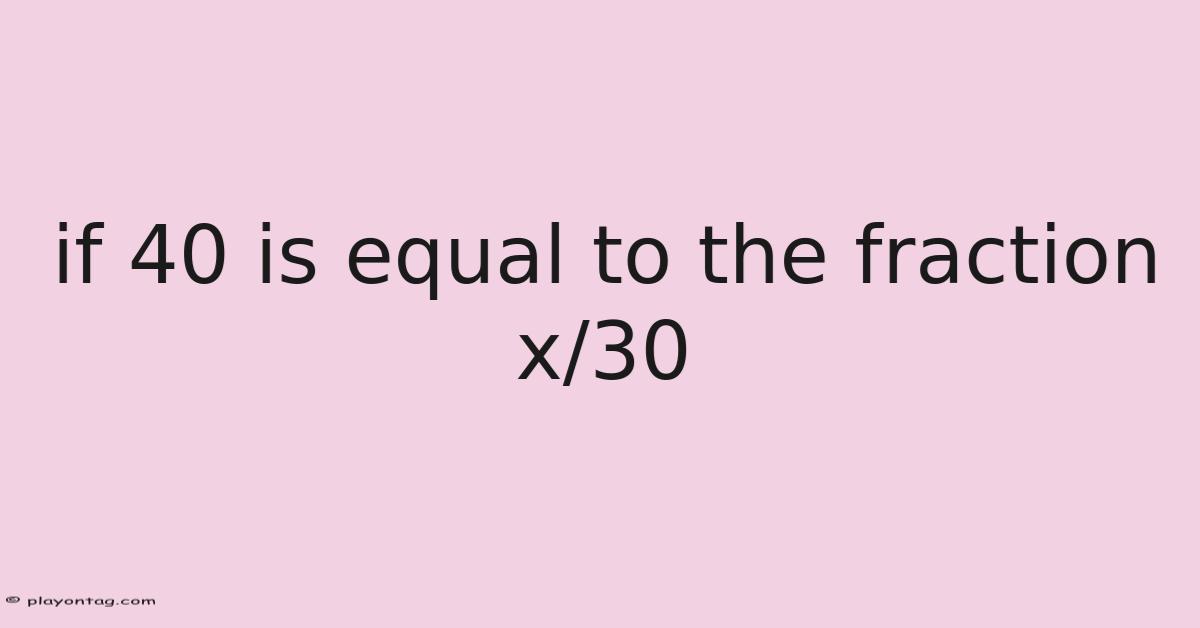
You're staring at a problem: If 40 is equal to the fraction x/30, what is x?*
Maybe it showed up on a homework assignment. Maybe you're prepping for a test. Maybe you just saw it in a puzzle book and your brain went "wait, what?
Here's the answer: x = 1,200. But it adds up.
But if you only came for the number, you're missing the part that actually matters — the why and the how. Because this exact structure shows up everywhere. Unit conversions. Scaling recipes. Figuring out how many hours of freelance work you need to hit a revenue target. The numbers change. The logic doesn't.
Let's walk through it properly.
What Is a Proportion, Really
A proportion is just two fractions that are equal to each other. That's it. No fancy definition needed.
When you write:
40 = x/30
You're saying: the value 40 is the same as some unknown number divided by 30.*
Most people freeze at the "x." But x isn't scary. It's just a placeholder. A blank line waiting to be filled in.
40 = ☐ / 30
Same thing. The letter doesn't matter. The relationship does.
The Hidden Denominator
Here's what trips people up: 40 doesn't look like a fraction.
But it is. Every whole number is a fraction with a denominator of 1.
40 = 40/1
So the equation is really:
40/1 = x/30
Two fractions. Here's the thing — that's a proportion. Equal to each other. And proportions follow rules — reliable, predictable rules that work every single time.
Why This Structure Shows Up Everywhere
You're not just solving for x. You're learning a pattern that appears in:
- Cooking: "The recipe calls for 2 cups of flour for 4 servings. I need 10 servings. How much flour?"
- Maps: "1 inch equals 50 miles. The distance on the map is 3.5 inches. How far is it really?"
- Finance: "I earn $40/hour. How many hours to make $1,200?"
- Chemistry: "The concentration is 40mg per 1mL. How many mg in 30mL?"
- Speed/distance/time: "I'm going 40 mph. How far in 30 hours?"
All of these are the exact same math*. The labels change. The numbers change. The structure is identical.
40 = x/30 is just the stripped-down version.
How to Solve It — Three Ways That All Work
There isn't one "right" method. There are a few. Use whichever clicks for you.
Method 1: Cross-Multiplication (The Standard Way)
This is what they teach in most algebra classes. It works because if two fractions are equal, their cross-products are equal.
40/1 = x/30
Multiply diagonally:
40 × 30 = 1 × x
1,200 = x
Done.
Why does this work? Because you're doing the same thing to both sides — multiplying by the denominators to clear them. But it's valid. Still, it's fast. It's reliable.
But — and this matters — don't just memorize the motion. Know why it works. Otherwise you'll misapply it when the problem looks slightly different (like when there are variables on both sides, or when you have addition in the numerator).
Method 2: Scale the Denominator (The Intuitive Way)
Look at the denominators: 1 and 30.
To go from 1 to 30, you multiply by 30.
Since the fractions are equal, you have to do the same thing to the numerator*.
40 × 30 = 1,200
So x = 1,200.
This is often faster mentally. Plus, you're asking: "What number, when divided by 30, gives 40? That's why " Well, if dividing by 30 gives 40, then multiplying 40 by 30 gives the number. Inverse operations.
Method 3: Isolate x Algebraically (The "Show Your Work" Way)
Start with:
If you found this helpful, you might also enjoy journal of chemical theory and computation impact factor or how many periods are in the periodic table.
40 = x/30
Multiply both sides by 30:
40 × 30 = (x/30) × 30
1,200 = x
This is the most transparent method. Every step is justified. You're not "crossing" anything — you're using the multiplication property of equality. It scales up to harder problems without breaking.
All three give the same answer. Pick the one that makes you say "oh, right."
Common Mistakes — And Why They Happen
I've seen smart people mess this up. Here's where it goes wrong.
Mistake 1: Dividing Instead of Multiplying
Wrong: x = 40 ÷ 30 = 1.33...
Why it happens: You see a fraction and your brain defaults to "divide." But x is in the numerator*. To undo division by 30, you multiply by 30.
Check: Does 1.33/30 = 40? No. It's 0.044. Not even close.
Mistake 2: Cross-Multiplying Wrong
Wrong: 40 × 1 = x × 30 → 40 = 30x → x = 4/3
Why it happens: You crossed the wrong pairs. Cross-multiplication means: numerator of first × denominator of second = denominator of first × numerator of second.*
40/1 = x/30 → 40 × 30 = 1 × x
Not 40 × 1. In real terms, the 1 is the denominator of the first fraction. The 30 is the denominator of the second. Cross means across*.
Mistake 3: Forgetting the Invisible Denominator
Wrong: "40 isn't a fraction, so I can't cross-multiply."
Fix: Write the 1. 40/1. Always. Until it's automatic.
Mistake 4: Decimal Panic
Wrong: Converting to decimals too early. 40 = x/30 → x = 1200. Clean. But if the problem was 40 = x/27, you'd get x = 1080. Still clean. Decimals introduce rounding errors and hide the relationship.
Stay in fractions as long as possible.
Practical Tips — What Actually Works
1. Write the 1
Every time. 40/1 = x/30. It takes two seconds and prevents 80% of errors.
2. Estimate First
Before calculating, ballpark it.
"x divided by 30 equals 40. So x is 30 times 40. That's 3 × 4 with two zeros → 1,200.
If your answer isn't in the thousands, you messed up.
3. Check by Plugging Back
**1,2
00 / 30 = 40.**
It works. It’s perfect. If you plug your answer back into the original equation and it doesn't hold up, you know immediately that you made a calculation error.
Summary Table: Which Method Should You Use?
| Method | Best For... | Pros | Cons |
|---|---|---|---|
| Scaling (Mental) | Simple numbers | Extremely fast; great for exams | Harder with large or prime numbers |
| Cross-Multiplication | Complex fractions | Works every single time | Easy to mix up the pairs |
| Algebraic Isolation | Harder problems / Exams | Very clear; no "magic" steps | Takes a bit more writing |
Conclusion
Solving for $x$ in a proportion is one of those fundamental skills that bridges the gap between basic arithmetic and advanced algebra. Whether you are scaling a recipe in the kitchen, calculating interest rates in finance, or solving for a variable in a physics equation, the logic remains the same.
The "secret" isn't about being a math genius; it's about choosing the right tool for the job and, most importantly, checking your work. If you can master the ability to see the relationship between the numerator and the denominator, you won't just be memorizing a trick—you'll be understanding how numbers move together.
Keep practicing, write out your steps, and when in doubt, always remember to write that invisible 1.
