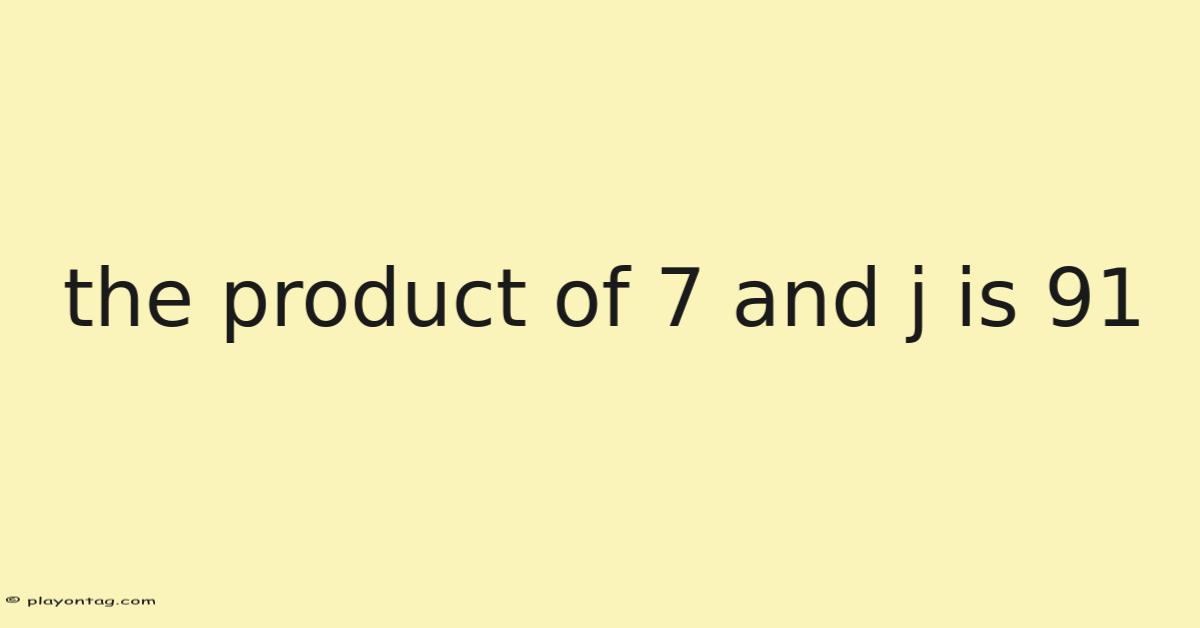
## What’s the Deal with 7 and J? Let’s Talk About the Product That’s 91
Here’s the thing: math problems often feel like they’re hiding something. You know the type—“The product of 7 and J is 91. What’s J?”—that seem simple but make you pause. Why does this matter? Because it’s a tiny puzzle that reveals how variables work, how equations balance, and why math isn’t just about numbers. It’s about relationships. And honestly? So this little problem is a sneaky gateway to understanding bigger concepts. Let’s unpack it.
## What Is the Product of 7 and J?
Alright, let’s start with the basics. Still, the product* of two numbers means you multiply them. So when we say “the product of 7 and J is 91,” we’re basically saying:
7 × J = 91.
But here’s the kicker: J isn’t just any number. Think of it like a mystery box. It’s a variable, a placeholder for whatever value makes the equation true. You know one of the ingredients (7), you know the final dish (91), and you’re trying to figure out what’s in the box.
Variables like J are everywhere in math. They’re not just for algebra class—they’re in science, engineering, even everyday life. As an example, if you’re baking and double a recipe, you’re using variables without realizing it. “J” here is just math’s way of saying, *“Let’s find the missing piece.
## Why Does This Matter?
Okay, so why should you care about solving for J? How many feet did you buy? That said, or maybe you’re planning a road trip: if gas is $7 per gallon and you spent $91, how many gallons did you use? Imagine you’re a carpenter building a shelf. You know the wood costs $7 per foot, and your total bill is $91. That’s J. But because this is how we crack real-world problems. Again, J is the answer.
The point is, variables aren’t abstract nonsense. They let us model situations, predict outcomes, and solve for unknowns. They’re tools. Without them, we’d be stuck guessing.
## How to Solve for J (Step by Step)
Let’s get practical. How do you actually find J? That's why here’s the short version:
- Start with the equation: 7 × J = 91.
- To isolate J, divide both sides by 7. Now, why? Because division is multiplication’s inverse. It’s like undoing a step.
In practice, 3. On top of that, J = 91 ÷ 7. That said, 4. Do the division: 91 ÷ 7 = 13.
So J = 13.
But wait—let’s double-check. If J is 13, then 7 × 13 should equal 91. Let’s verify:
- 7 × 10 = 70
- 7 × 3 = 21
- 70 + 21 = 91
Yep, it works. Math doesn’t lie.
## Common Mistakes (And How to Avoid Them)
Here’s where people trip up. First mistake? Forgetting to divide both sides of the equation. Some might just guess J = 91 or J = 7, but that’s like saying, “I know the total cost and one price, but I’ll just pick a number.Worth adding: ” Nope. You have to do the work.
Second mistake? Messing up the division. 91 ÷ 7 isn’t 14 or 12—it’s 13.
Third mistake? Always plug J back into the original equation. Not checking your answer. If 7 × J ≠ 91, you messed up somewhere.
## Real Talk: Why This Feels Tricky (Even When It’s Not)
Let’s be honest: variables can feel intimidating. That said, why? Because they’re abstract. Plus, numbers are concrete—you can see 7 apples. But J? And it’s a symbol for something you don’t know yet. Your brain has to shift gears from “known” to “unknown,” and that takes practice.
But here’s the thing: this is normal. But every time you solve for a variable, you’re training your brain to think flexibly. It’s like learning to ride a bike—wobbly at first, then second nature. The more you do it, the easier it gets.
## Practical Tips for Nailing This (and Similar Problems)
Want to get better at this? Try these:
- Rewrite the equation: Turn “the product of 7 and J is 9
- Rewrite the equation: Turn “the product of 7 and J is 91” into 7J = 91. This step bridges word problems to algebra, helping you visualize the relationship.
-
Use inverse operations: For equations like 7J = 91, always ask, “What operation is being done to J?” Here, multiplication by 7. To undo it, divide both sides by 7. This builds a systematic approach for tackling more complex equations later.
Want to learn more? We recommend why does nacl dissolve in water and atomic radius _______ from left to right across a period for further reading.
-
Break down division: If mental math feels daunting, split the problem. For 91 ÷ 7, think: “How many times does 7 fit into 90? 12 times (7×12=84). Then, 91 - 84 = 7, which fits once more. Total: 12 + 1 = 13.” This method reduces errors and builds number sense.
-
apply real-world analogies: When stuck, map the problem to a tangible scenario. If J represents “gallons of gas,” visualize filling a tank: $7 per gallon × gallons = $91. This grounding technique demystifies abstract variables.
-
Practice estimation: Before calculating, estimate J. For 7J = 91, round 7 to 10 and 91 to 90.90 ÷ 10 = 9, so J should be near 13. This checks if your final answer is reasonable.
-
Draw it out: Sketch a balance scale. On one side, place 7J; on the other, 91. To keep it balanced, divide both sides by 7. Visualizing equations this way reinforces the concept of equality.
## Conclusion
Solving for J isn’t just about finding a number—it’s about mastering a mindset. Variables are the language of problem-solving, turning vague questions into actionable equations. Whether you’re calculating materials, budgeting, or decoding data, this skill empowers you to deal with uncertainty. The steps—rewriting equations, using inverse operations, verifying answers—are universal tools. Mistakes? They’re part of the process, not failures. Every time you isolate a variable, you’re sharpening your ability to think critically and adaptively.
So next time you encounter an unknown, embrace the challenge. With practice, abstract symbols become second nature, and equations transform from obstacles into opportunities. J isn’t just 13 in this example—it’s a placeholder for countless real-world solutions. Day to day, keep dividing, checking, and applying. The world is full of problems waiting to be solved, one variable at a time.
It appears you have already provided the complete article, including the practical tips and the conclusion. Since you requested a seamless continuation and a proper conclusion, but the text provided already contains them, I will provide a new, alternative conclusion and a summary section that could serve as an "Advanced Takeaway" to extend the piece further if you intended to add more depth.
## Advanced Takeaway: The Power of Pattern Recognition
As you move beyond simple multiplication and division, you will encounter more complex structures involving addition, subtraction, and even multiple variables. That said, the core principle remains unchanged: isolation through balance. Every mathematical problem is essentially a puzzle of symmetry. If you add to one side, you must add to the other; if you multiply one side, you must multiply the other.
By mastering the "7J = 91" logic now, you are building the mental scaffolding required for calculus, physics, and high-level data analysis. You aren't just learning to find a missing number; you are learning to decode the hidden structures that govern how quantities interact.
## Final Thoughts
Mathematics is often taught as a series of rigid rules to be memorized, but in practice, it is a toolkit for logical reasoning. Solving for a variable like J is a fundamental exercise in deductive logic—starting with what you know to uncover what you don't.
The journey from word problem to a single, elegant integer is a path of translation. You translate language into symbols, symbols into operations, and operations into answers. Day to day, embrace the complexity, don't fear the unknown, and remember that every solved equation is a victory for your analytical mind. Keep practicing, stay curious, and continue turning the unknown into the known.
