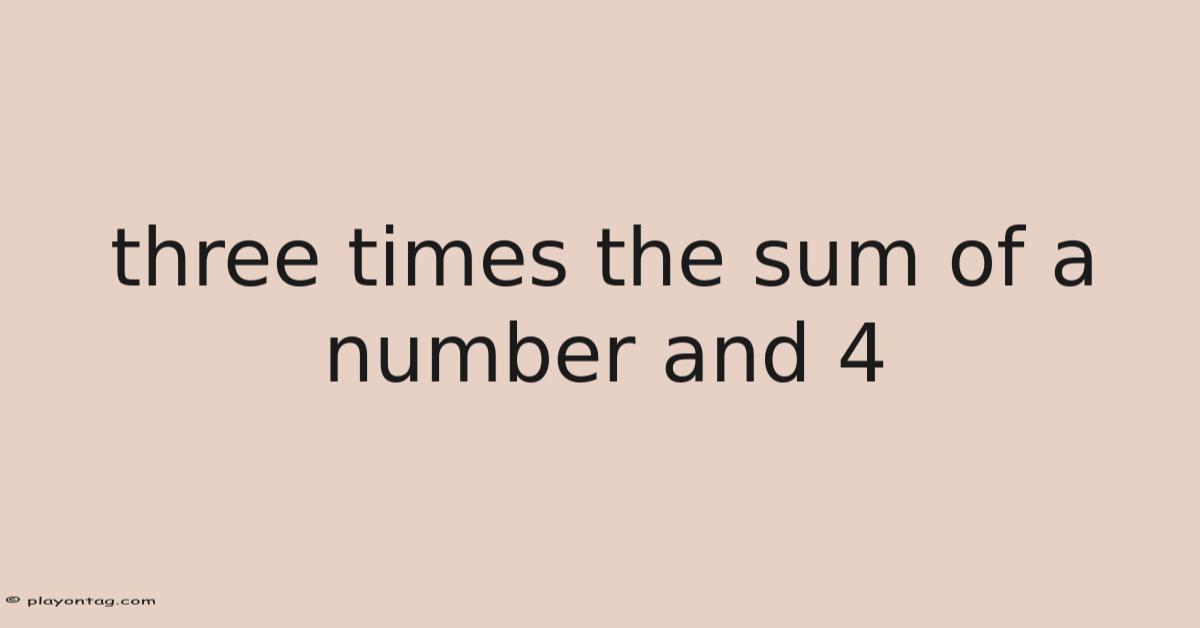
Understanding Three Times the Sum of a Number and 4: A Practical Guide
Have you ever looked at a math problem and felt like your brain just... I still am. I've been there. Also, that little mental hiccup happens to everyone eventually—until you internalize how these expressions work. Something as simple as "what is three times the sum of a number and 4" can trip you up if you're not careful. So froze? Once you do, it stops feeling like a puzzle and starts feeling like a tool you can actually use.
This concept might look intimidating at first glance, but it's really just algebra dressed up in plain English. Consider this: whether you're trying to figure out a tip calculation, a discount promotion, or even a quick mental math shortcut, understanding this expression can make your life easier. In this post, we'll break down exactly what "three times the sum of a number and 4" means, why it matters in real life, and how to master it so you never get stuck again.
What Is Three Times the Sum of a Number and 4
At its core, this expression is a straightforward algebraic formula. Now, take that number and add 4 to it. Let me walk through it piece by piece. Imagine you have a variable—let's call it n. But that represents any number you choose. That gives you the "sum" part—the total after you've added 4 to whatever number you started with.
Once you have that sum, you multiply it by 3. So the full expression reads: 3 × (n + 4). Now, that's the entire formula. On the flip side, simple enough, right? But there's something subtle happening here that often trips people up. The parentheses mean you add 4 first, then multiply. If you forget that order and try to multiply the number by 4 first before adding, you'll end up with a completely different result—and a wrong answer.
Let me show you with actual numbers. That's the key. In practice, many people instinctively do 3n + 4 instead of 3(n + 4), which is a classic mistake. Notice how the "+4" gets incorporated into the base before the multiplication kicks in? So 3 × (5 + 4) = 27. If n equals 5, then the sum of 5 and 4 is 9, and three times that is 27. On top of that, if n is 10, then 3 × (10 + 4) = 42. The difference between those two approaches can be huge depending on the value of n.
You can also think of this as a transformation. Whatever number you plug in gets shifted up by 4, and then that whole new number gets scaled by 3. It's like a two-step operation: first shift, then stretch. That mental model makes it much easier to remember.
Why It Matters / Why People Care
Now, you might wonder: why should anyone care about "three times the sum of a number and 4"? Honestly, it seems like such a niche math problem. But here's the thing—this pattern appears everywhere in everyday life, often disguised under different names.
Consider a restaurant bill. Or picture a store sale where everything costs "three times the original price plus $4 extra"—that's essentially the same structure, just with slightly different wording. Suppose you order a meal and your friend says, "The total is three times the sum of my portion and four dollars.Even so, " That could mean they're calculating a tax or a tip based on a specific rule. These aren't just random formulas; they're models for how businesses and individuals handle pricing, taxes, fees, and discounts.
On a personal finance level, this expression shows up constantly. When you negotiate a salary raise, the employer might offer a percentage increase above a base amount. If their policy is "your new pay is three times the sum of your current salary and a fixed bonus of $4 per year," you need to understand this formula to evaluate whether the deal is fair. Similarly, if you're calculating a monthly savings target where you want to save three times your income plus an additional $4 each month, knowing the correct computation saves you from making costly mistakes.
Beyond practical calculations, this concept teaches an important lesson about order of operations—a fundamental skill that protects you from errors in almost any quantitative field. So when you get the answer wrong because you didn't follow the proper sequence, it's a reminder that math isn't arbitrary; it follows rules designed to keep things consistent. Mastering this simple expression builds confidence that carries over to more complex problems.
How It Works (Step by Step)
Alright, let's get practical. Here's exactly how you should approach calculating "three times the sum of a number and 4" every time you encounter it.
Step 1: Identify Your Variable
First, decide what number you're working with. Call it n. Make sure it's clear what type of number you're dealing with—integer, decimal, fraction, negative? The method stays the same regardless of the type, though the arithmetic will differ slightly.
Continue exploring with our guides on when sugar dissolves in water what happens and impact factor crystal growth and design.
Step 2: Add 4 to the Number
Take your n and add 4. This creates the inner sum. Write it as n + 4. Consider this: if n is 7, this becomes 11. That said, if n is -3, this becomes 1. The addition comes first, always.
Step 3: Multiply by 3
Now take that resulting sum and multiply it by 3. So you compute 3 × (n + 4). That's the final answer.
Step 4: Verify with Alternative Methods
Want to double-check? You can expand the expression algebraically: 3 × (n + 4) = 3n + 12. Worth adding: if n is 5, then 3(5 + 4) = 27, and 3(5) + 12 = 15 + 12 = 27. Both forms should give you the same result. They match.
This expansion trick is useful for verification and for simplifying algebraic manipulations, especially when you need to combine like terms or solve equations. Here's a good example: if you encounter an equation like (3(n+4) - 2n = 10), expanding first makes it easier to isolate (n):
[ 3n + 12 - 2n = 10 ;\rightarrow; n + 12 = 10 ;\rightarrow; n = -2. ]
Common Pitfalls to Avoid
A frequent slip is to multiply before adding, interpreting the phrase as “three times a number, then add four” ((3n + 4)). That changes the outcome dramatically. Always remember that the wording “the sum of a number and 4” groups the addition first, which is why parentheses (or an explicit step) are essential.
Visualizing the Process
An area model can help cement the idea. Imagine a rectangle whose width is 3 and whose length is divided into two parts: one segment labeled (n) and the other labeled 4. The total area represents (3 \times (n+4)). Splitting the rectangle into two smaller rectangles—one of area (3n) and another of area (12)—visually demonstrates why the expanded form (3n + 12) yields the same result.
Real‑World Extensions
Beyond salary negotiations or savings plans, the same structure appears in:
- Bulk discounts: A wholesaler charges “three times the unit price plus a handling fee of $4” for each pallet ordered.
- Travel reimbursements: Some companies compute mileage pay as “three times the distance traveled (in miles) plus a $4 base stipend.”
- Recipe scaling: If a recipe calls for “three times the sum of the base ingredient amount and 4 g of spice,” you’d first add the spice, then triple the mixture.
In each case, correctly applying the order of operations prevents over‑ or under‑payment, ensures accurate budgeting, and maintains consistency across transactions.
Building Confidence with Practice
Try these quick checks:
-
Let (n = 0). What is (3(n+4))?
Answer:* (3 \times 4 = 12). -
Let (n = -5). What is (3(n+4))?
Answer:* (3 \times (-1) = -3). -
Solve for (n) if (3(n+4) = 21).
Answer:* Divide both sides by 3 → (n+4 = 7) → (n = 3).
Working through varied numbers—integers, negatives, fractions—reinforces that the procedure remains unchanged regardless of the value’s type.
Conclusion
Mastering the computation of “three times the sum of a number and 4” does more than give you a correct arithmetic answer; it trains you to respect grouping symbols, to verify results through algebraic expansion, and to translate everyday scenarios into reliable mathematical models. By internalizing the sequence—add first, then multiply—you safeguard against costly errors in finance, shopping, cooking, and countless other quantitative tasks. This simple expression, therefore, serves as a stepping stone to tackling far more complex problems with confidence and precision.
