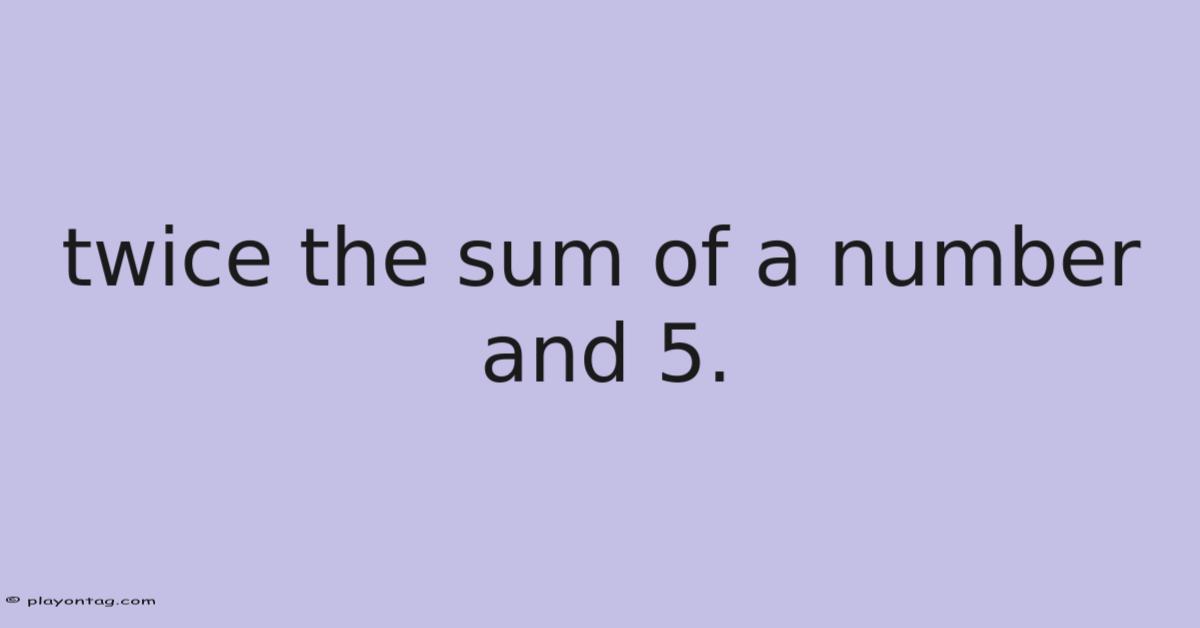
What Is "Twice the Sum of a Number and 5"?
Let's start with the basics. So when someone says "twice the sum of a number and 5," they're talking about a math expression. Specifically, it's 2(n + 5), where n is your unknown number.
The key here is understanding the order of operations. So you don't multiply first and then add — that's where most people trip up. The "sum" comes first, meaning you add the number and 5 together, then double the result.
So if your number is 3, you'd calculate (3 + 5) = 8, then double it to get 16. Simple enough, right?
Breaking Down the Language
Math word problems can feel like translation exercises. On top of that, "Sum" means addition. "Twice" means multiply by 2. "Of" often indicates multiplication in mathematical contexts.
When these phrases stack up like building blocks, you get a structured expression. The parentheses become crucial — they're the mathematical equivalent of putting a phrase in quotes to highlight it.
Why Does This Matter?
You might be wondering why you'd ever need to express this particular mathematical relationship. Turns out, it pops up more often than you'd think.
In business, you might be calculating profits where your base revenue plus a fixed amount gets doubled. Worth adding: in cooking, scaling recipes often involves similar proportional increases. Even in fitness, calculating calorie needs sometimes follows patterns like this.
But more importantly, understanding how to translate words into mathematical expressions is a fundamental skill. It's the bridge between real-world problems and solvable equations.
Real-World Applications
Let's say you're running a lemonade stand. That's why your fixed costs are $5 per day, and you want to calculate your potential earnings if you double your sales plus that fixed amount. Or imagine you're planning a party where you need twice as many drinks as guests plus 5 extra bottles for safety.
These aren't just abstract math problems — they're templates for solving actual problems you'll encounter.
How It Works: The Mathematical Breakdown
Let's get into the nitty-gritty of how this expression functions.
The Algebraic Expression
Starting with 2(n + 5), you can also write this as 2n + 10 using the distributive property. This expanded form shows that doubling a sum is the same as doubling each part separately and then adding them.
Both forms are mathematically equivalent, but they serve different purposes. The factored form 2(n + 5) makes the structure clear, while the expanded form 2n + 10 is often easier for calculations.
Working with Specific Numbers
Let's test this with a few examples to see how it behaves:
- If n = 1: 2(1 + 5) = 2(6) = 12, or 2(1) + 10 = 2 + 10 = 12
- If n = 0: 2(0 + 5) = 2(5) = 10, or 2(0) + 10 = 0 + 10 = 10
- If n = -5: 2(-5 + 5) = 2(0) = 0, or 2(-5) + 10 = -10 + 10 = 0
Notice something interesting? When n = -5, the result is zero. That's because you're doubling the sum of -5 and 5, which equals zero.
Solving Equations with This Expression
What if you need to solve for n when twice the sum equals a specific value?
If 2(n + 5) = 24, then:
- n + 5 = 12
- n = 7
Check: 2(7 + 5) = 2(12) = 24. Perfect.
Common Mistakes People Make
I've seen these errors countless times, and honestly, they're easy to make if you're not careful.
Order of Operations Confusion
The most frequent mistake is calculating 2n + 5 instead of 2(n + 5). These give different results:
- For n = 3: 2n + 5 = 2(3) + 5 = 6 + 5 = 11
- But 2(n + 5) = 2(3 + 5) = 2(8) = 16
That's a significant difference. The parentheses aren't just decorative — they change everything.
Distribution Errors
When expanding 2(n + 5), some people forget to distribute the 2 to both terms:
Want to learn more? We recommend journal of chemical information and modeling and journal of physical chemistry letters impact factor for further reading.
- Wrong: 2n + 5
- Right: 2n + 10
The distributive property requires multiplying the outside number by each term inside the parentheses.
Sign Errors with Negative Numbers
Negative numbers trip people up regularly. If n = -8:
- 2(n + 5) = 2(-8 + 5) = 2(-3) = -6
- Not 2(-8) + 5 = -16 + 5 = -11
The sum happens first, and that sum can be negative, which then gets doubled.
Practical Tips That Actually Work
Here's what I've learned works best when dealing with expressions like this:
Always Use Parentheses as Your Guide
Think of parentheses as mathematical parentheses — they create a "group" that should be treated as a single unit. Before you do anything else, figure out what's inside those virtual parentheses.
Test with Simple Numbers First
Pick an easy number like 1, 2, or 10 and work through both forms of the expression. If you get the same answer, you're on the right track.
Draw It Out
Sometimes it helps to write out the steps visually:
- Step 1: Take your number n
- Step 2: Add 5 to it
- Step 3: Double the result
This simple visualization can prevent many errors.
Check Your Work Backwards
After solving an equation or simplifying an expression, plug your answer back into the original problem. If it checks out, you're good. If not, start over.
FAQ
What does "twice the sum of a number and 5" mean in math terms?
It means you take a number (let's call it n), add 5 to it, then multiply the result by 2. Written as 2(n + 5).
How is this different from "twice a number plus 5"?
Big difference! "Twice the sum of a number and 5" is 2(n + 5) = 2n + 10, while "twice a number plus 5" is 2n + 5. The parentheses completely change the meaning.
Can the result be negative?
Yes, absolutely. Now, if your number is less than -5, then (n + 5) will be negative, and doubling a negative number gives you another negative number. Here's one way to look at it: if n = -7, then 2(-7 + 5) = 2(-2) = -4.
How do you solve for the number when given the result?
Set up the equation 2(n + 5) = your result, then solve for n. Divide both sides by 2, then subtract 5 from both sides.
Is there a real-world scenario where this calculation matters?
Definitely. Any time you have a base amount plus a fixed addition that then gets doubled — like calculating total costs with a base fee plus fixed expenses, then applying a multiplier for risk or scaling.
The Bigger Picture
Understanding expressions like "twice the sum of a number and 5" isn't just about passing algebra class. It's about developing a way of thinking that helps you break down complex problems into manageable pieces.
The real skill here isn't memorizing formulas — it's learning to translate between natural language and mathematical notation. That translation ability serves you well beyond math class, whether you're analyzing business data, planning projects, or just making sense of numerical information in daily life.
So the next time you encounter a word problem, remember: take it one phrase at a time, identify what operations each word suggests, and build your expression step by step. The structure will become clearer with practice, and soon you'll spot these patterns everywhere.
The short version is this
The short version is this: start with a number, add five, and then double the total. Consider this: it’s a simple sequence, but mastering it is your first step in unlocking the logic behind countless real-world calculations. Keep practicing, and the patterns will become second nature.
